When you tour a property, it’s easy to assume the agent showing the space is helping you make the best decision for your situation. What I’ve seen with clients, though, is that many people realize much later that the agent they trusted was actually representing the landlord’s interests the entire time.
That difference can directly affect rent negotiations, lease flexibility, improvement allowances, and long-term costs. Recent CBRE data showed that new office leases in 2024 averaged 8.9 months of free rent along with tenant improvement allowances averaging $87.51 per sq. ft. across major U.S. markets. Many people never negotiate for concessions at that level simply because they do not realize those terms are achievable.
In my experience, this is usually where lease decisions start feeling overwhelming. The monthly rent number gets most of the attention, but the details inside the lease are often what create stress later. Understanding who is actually representing your interests helps you negotiate with more clarity and avoid agreeing to terms that feel restrictive once the lease is already signed.
Your Quick Summary
- Represented tenants secured an average of 8.9 months of free rent and tenant improvement allowances averaging $87.51 per sq. ft. in 2024 market data.
- Tenant representatives negotiate for lower costs, flexibility, and lease protections, while owner representatives focus on maximizing rental income and lease stability.
- Landlords typically pay both brokerage commissions, so tenant representation usually comes at no direct out-of-pocket cost to the tenant.
- Dual agency creates limits on advocacy because one agent cannot fully protect both sides of the negotiation at the same time.
- Small staging and layout improvements often help properties lease faster because people can more easily picture how the space would function day to day.
What is Tenant Representation?
Tenant representation is a licensed brokerage service where a real estate agent works exclusively for the person or business seeking to lease or rent property, whether commercial office space, retail locations, or residential units. Unlike listing agents who represent property owners, tenant representatives act as advocates, advisors, and negotiators solely on behalf of the tenant.
A fiduciary duty defines this relationship: the representative must prioritize the tenant's interests above all else, including their own commission potential. This means identifying properties that genuinely fit the client's needs - not just those offering the highest broker fees, which is the misaligned incentive that makes unrepresented tenants vulnerable.
Key Responsibilities Throughout the Leasing Process
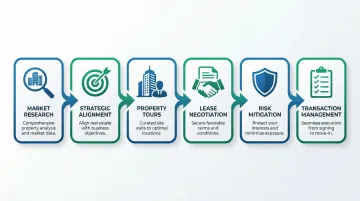
Tenant representatives manage the entire leasing process:
- Market research and property identification - Analyzing comparable rates, identifying suitable properties across multiple buildings and landlords, and presenting objective options
- Strategic alignment - Connecting real estate decisions to business goals like workforce strategy, supply chain logistics, and growth projections
- Property tours and evaluation - Coordinating showings, assessing space functionality, and identifying potential issues or improvement costs
- Lease negotiation - Securing favorable terms including rent reductions, improvement allowances, flexible clauses, and exit options - knowing that someone is negotiating purely for your interests removes the uncertainty of whether you're leaving concessions on the table
- Risk mitigation - Protecting tenants from unfavorable lease language, hidden costs, and landlord-favorable clauses
- Transaction management - Coordinating lease execution, reviewing legal documents, and ensuring all terms are properly documented
This is usually where representation starts making a real financial difference. Many tenants agree to lease terms without realizing that free rent periods, build-out allowances, renewal flexibility, and operating expense protections are often negotiable before signing.
If you’re unsure what concessions, lease flexibility, or improvement allowances are realistically negotiable before signing, call 408-306-5003 for a free consultation to better understand what leverage may exist in your market.
When Tenant Representation is Most Valuable
Tenant representation delivers maximum value in these scenarios:
- First-time commercial tenants. If you are unfamiliar with lease structures, market rates, or negotiation leverage points
- Complex negotiations. Multi-year leases, build-out requirements, or transactions involving significant financial commitment
- Competitive markets. When it’s hard to tell what’s actually a fair deal
- Market bifurcation. When Class A rents rise by 2.4% while Class B/C rents fall by 1.2%, requiring strategic guidance on where leverage exists
- Relocations or expansions - When business continuity depends on securing the right space at the right terms
For residential tenants, including homeowners exploring temporary rentals, securing long-term properties, or listing agents advising clients, the value becomes clear in practical terms.
How Tenant Representatives Are Paid
Tenant representation typically costs tenants nothing out-of-pocket.
Standard payment structure:
- Landlords pay brokerage commissions as part of transaction costs
- The total commission (often 6% of gross rent over the lease term) is split between the landlord's representative and the tenant's representative
- Example split: In markets like Austin, Texas, a typical structure is 4% to the tenant representative and 2% to the landlord representative
Calculation basis: Commission = Commission Rate × (Base Rent + Operating Expenses) × Lease Term
Exceptions where tenants pay directly:
- Exclusive representation agreements for highly specialized searches
- Some complex commercial transactions requiring extensive market analysis
- International markets where fee structures differ from U.S. norms
The financial benefit is clear: tenants receive professional advocacy that typically secures concessions worth tens of thousands of dollars, without direct fees.
What is Owner/Landlord Representation?
Owner or landlord representation is a brokerage service where an agent works exclusively for property owners seeking to lease, rent, or sell their properties.
These representatives focus on maximizing property value, minimizing vacancy periods, and securing qualified, creditworthy tenants who will protect long-term asset value.
The landlord representative's fiduciary duty runs entirely to the property owner; they must prioritize rental income maximization and risk mitigation, even when those goals conflict with tenant interests.
Roles and Responsibilities
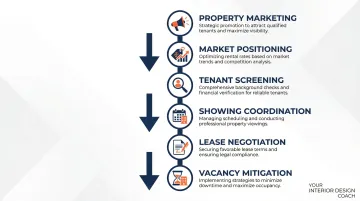
This fiduciary duty translates into specific responsibilities. Owner representatives handle comprehensive property marketing and transaction management:
- Property marketing: Creating compelling listings, professional photography, property descriptions, and targeted advertising campaigns
- Market positioning: Setting competitive rental rates based on comparable properties, market conditions, and asset quality
- Tenant screening: Qualifying prospects through credit checks, employment verification, rental history review, and financial analysis
- Showing coordination: Scheduling property tours, highlighting features, and addressing prospect questions
- Lease negotiation: Securing the highest possible rent, favorable escalation clauses, and protective lease terms
- Vacancy mitigation: Reducing time-on-market through strategic pricing and aggressive marketing
Professional landlord representation directly impacts financial performance. Vacancy risks can significantly reduce property valuations.
Owner representatives focus on structuring leases that stabilize revenue streams and protect net operating income (NOI).
Strategic Marketing and Tenant Placement
Owner representatives develop comprehensive marketing strategies:
Marketing components:
- Professional photography and virtual tours that showcase property features
- Posting listings across multiple platforms (MLS, commercial databases, property websites)
- Targeted outreach to tenant representatives and corporate real estate departments
- Market positioning that highlights competitive advantages and value propositions
Screening process:
- Financial qualification to ensure rent-paying ability
- Credit and background checks
- Previous landlord references
- Business stability assessment for commercial tenants
The goal is identifying qualified, reliable tenants who will pay rent consistently, maintain the property appropriately, and renew leases, protecting property value and owner cash flow.
Property Management vs. Owner Representation
While these roles may seem similar, they are distinct services serving different functions:
Owner representation:
- Focuses on leasing/selling transactions
- Marketing and tenant placement
- Lease negotiation and execution
- Transaction-based service (ends when the parties sign the lease)
Property management:
- Handles ongoing operations after lease execution
- Rent collection and financial reporting
- Maintenance and repairs
- Tenant relations and lease enforcement
Some firms offer both services, but they serve different stages of the property ownership lifecycle. Owner representation secures the tenant; property management maintains the relationship.
Key Differences Between Tenant and Owner Representation
Tenant and owner representation may look similar on the surface, but the priorities behind them are completely different. Tenant representatives focus on securing better lease terms and reducing long-term risk, while owner representatives focus on maximizing property value, rental income, and lease stability.
Understanding who the agent is actually working for makes negotiations much easier to navigate and helps you evaluate advice with more clarity.
Fiduciary Duty and Loyalty
The most critical difference is fiduciary duty, the legal obligation to act solely in one party's best interest.
Tenant representatives:
- Owe exclusive loyalty to tenants
- Push for lower rents, favorable terms, and maximum flexibility
- Maintain confidentiality about tenant budgets, timeline pressures, and negotiating limits
- Must disclose property issues or unfavorable lease terms that could harm the tenant
Owner representatives:
- Owe exclusive loyalty to property owners
- Seek higher rents, protective lease clauses, and long-term commitments
- Protect information about property issues, owner motivations, and bottom-line terms
- Must present offers objectively but advocate for owner interests
Dual agency warning: When one agent attempts to represent both parties, conflicts of interest are inevitable.
California law prohibits dual agents from disclosing confidential information like the lowest price a landlord will accept, limiting their ability to advocate effectively for either party.
Negotiation Strategy and Tactics
Representatives approach lease clauses with opposing priorities:
| Lease Term | Tenant Representative Focus | Owner Representative Focus |
|---|---|---|
| Rent amount | Minimize base rent; maximize free rent periods | Maximize base rent; maintain face rent for property valuation |
| Lease duration | Flexibility (shorter terms, renewal options, termination rights) | Stability (longer terms, 5-10+ years to reduce vacancy risk) |
| Tenant improvements | Maximize improvement allowances and flexibility in usage | Minimize capital outlay; amortize costs into rent |
| Operating expenses | Cap controllable expenses; audit rights; exclude capital improvements | Pass through all increases; maximize recoverable costs |
| Assignment/sublease | Broad rights without unreasonable consent restrictions | Strict control over occupant quality; recapture rights |
Trade-off example: Landlords often offer larger tenant improvement allowances and extended free rent periods in exchange for longer lease terms (10+ years).
This stabilizes revenue streams and supports property valuations.
Information Access and Confidentiality
Each representative maintains strict confidentiality about their client's position:
What tenant reps keep confidential:
- Maximum budget and rent-paying capacity
- Timeline pressures or urgency to secure space
- Alternative properties under consideration
- Specific business challenges driving the move
What owner reps keep confidential:
- Property issues or deferred maintenance
- Owner's financial pressures or motivation to lease quickly
- Minimum acceptable rent (bottom line)
- Other offers or interest level from prospects
Working directly with the "other side's" representative creates risk. Sharing sensitive information can weaken your negotiating position and result in less favorable terms.
Market Perspective and Property Selection
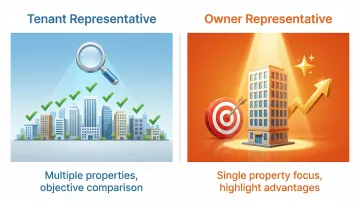
The breadth of options differs dramatically:
Tenant representatives:
- Show properties across multiple buildings, landlords, and submarkets
- Provide objective comparisons without bias toward specific properties
- Focus on finding the best fit for tenant needs, regardless of which property it is
Owner representatives:
- Focus exclusively on their client's properties
- Highlight their building's advantages
- May not disclose better options available in competing properties
This structural difference affects the objectivity of recommendations; tenant reps have no incentive to steer clients toward unsuitable properties, while owner reps are inherently focused on filling their client's vacancies.
When to Use Tenant vs. Owner Representation
For Tenants and Buyers
Seek dedicated tenant representation when:
- You're unfamiliar with local market rates, standard lease terms, or negotiation benchmarks
- The lease represents significant financial commitment (multi-year terms, high monthly costs)
- You need complex space requirements (build-outs, specific layouts, technical infrastructure)
- You're competing in a tight market where negotiating leverage is essential
- You're renewing an existing lease and want to ensure market-competitive terms
Tenant representation is typically free (landlord-paid), yet the value delivered often exceeds what you'd pay in direct fees.
Represented tenants secure an average of $87.51 per square foot in improvement allowances, potentially tens of thousands of dollars in value.
For Property Owners and Landlords
Consider professional owner representation when you need:
- Marketing expertise to reach qualified tenant pools
- Tenant screening to protect property value and ensure reliable rent payment
- Lease negotiations that need professional handling to secure favorable terms
- Help maximizing rental income and minimizing vacancy periods
- Support when you lack time or expertise to manage showings, negotiations, and transaction paperwork
DIY considerations:
Small residential property owners might handle representation themselves for informal arrangements or simple month-to-month leases. For commercial properties, multi-unit residential buildings, or complex lease structures, professional representation typically delivers better financial outcomes.
For Real Estate Agents
Agents must clarify their representation role at the outset of client relationships. State laws require specific disclosures to protect all parties involved.
Legal and ethical requirements:
- Texas requires written disclosure of representation status before showing properties
- Illinois mandates written consent for dual agency situations
- New York requires disclosure of duties owed to each party
Benefits of Professional Representation in Real Estate Transactions
Real estate representatives provide critical market intelligence that most tenants and buyers can't access on their own:
- Comparable rates - Knowledge of recent lease transactions, rental rates, and market trends
- Concession benchmarks - Understanding that 8.9 months of free rent is the current average, not an exceptional ask
- Property values - Insight into which buildings command premium rates and which offer negotiation leverage
- Transaction best practices - Experience with lease structures, common pitfalls, and protective clauses
These insights directly improve financial outcomes. While base rents in top-tier buildings grew 3% annually, effective rents (including concessions) grew more slowly or declined in lower-tier assets, creating significant savings opportunities for informed tenants.
Negotiation Power and Advocacy
When you have a dedicated representative, you gain:
- Skilled negotiation - Professional training in lease negotiation tactics and strategies
- Emotional distance - Objective decision-making without personal attachment clouding judgment
- Leverage through knowledge - Using market data to justify requests and counter unreasonable demands
- Protection of interests - Identifying and eliminating unfavorable lease language before signing
Common negotiation wins:
- Rent reductions of 5-15% below initial asking rates
- Extended free rent periods (averaging 8.9 months in 2024)
- Tenant improvement allowances averaging $87.51 per square foot
- Flexible termination clauses and renewal options
Time and Stress Savings
Representatives handle the heavy lifting:
- Property searches across multiple listings and submarkets
- Scheduling and coordinating property tours
- Reviewing and explaining complex lease documents
- Managing due diligence, inspections, and transaction paperwork
- Problem-solving when issues arise during negotiations
Hidden costs of DIY representation:
- Missed opportunities due to limited market knowledge
- Unfavorable terms that cost thousands over the lease term
- Time investment that pulls focus from core business or personal priorities
For business owners and property investors, the time saved alone often justifies professional representation, before the superior financial terms achieved.
How Interior Design Impacts Representation Success
Professional staging and interior design significantly impact leasing velocity and rental rates. According to a 2025 National Association of Realtors report, staging delivers measurable results:
- 49% of agents observed that staging reduced time on market
- 29% of agents reported staging increased offer values by 1-10%
- 83% of agents noted staging made it easier for prospects to visualize the property as their future space - when prospects can picture themselves in the space during the showing, the leasing conversation shifts from evaluation to commitment
Key staging priorities:
- Living room (37% of agents cite as most important)
- Primary bedroom (34%)
- Kitchen (23%)

You can have a property with the right location and pricing, but I’ve seen tenants lose interest quickly when the layout feels awkward or the space feels difficult to picture themselves using day to day.
Layout clarity and functional presentation often influence leasing momentum more than people expect, especially when prospects are comparing multiple properties with similar pricing or location advantages.
If you want a second opinion on how to make your property feel more functional and easier to present during showings, reach out for a free consultation at 408-306-5003, and we can talk through a few practical ideas together.
Design Considerations for Tenants
Tenant representatives should evaluate properties through a design lens:
- Space functionality - Does the layout support the tenant's operational needs?
- Layout efficiency - Are there wasted spaces or awkward configurations?
- Improvement costs - What build-out or renovation expenses will the tenant face?
- Design potential - Can the space be transformed cost-effectively to meet tenant requirements?
Understanding design and space planning helps tenant representatives negotiate better improvement allowances or identify properties requiring minimal tenant investment, saving clients significant capital.
Real estate agents working with tenants can partner with interior design coaches to help clients evaluate how efficiently a space can support operational needs, layout changes, or future improvements before committing to a lease. This is especially valuable for anyone evaluating properties that need improvements before moving in or opening to guests.
Your Quick Recap
Most people walk into lease negotiations without knowing what the current market average actually looks like. That information gap is worth tens of thousands of dollars in concessions over a typical lease term. Representation is not just about having someone negotiate - it is about knowing what is actually achievable before you walk into the room.
- Landlords always know the market; tenants rarely do - that information gap is where value is lost
- Professional tenant representation often gives tenants access to stronger negotiation leverage and market insight without adding significant upfront transaction costs.
- The 8.9-month free rent average is real leverage that unrepresented tenants routinely leave on the table
- Understanding who the agent legally represents changes how you evaluate negotiation advice, lease recommendations, and property guidance during the transaction.
- For Airbnb hosts securing long-term properties, tenant representation applies the same way it does for commercial tenants
- Real estate agents who understand layout presentation and staging strategy often position properties more effectively during leasing and showing discussions.
If you’re evaluating a property, preparing it for lease, or trying to understand how the space could function more effectively before signing an agreement, reach out at 408-306-5003 for a free consultation to better understand the next steps for your property or leasing strategy.
Frequently Asked Questions
What does tenant representation mean?
A tenant representative works exclusively for the tenant, advocating for lower rents, favorable lease terms, and maximum flexibility. The agent owes fiduciary duty to the tenant throughout property search and lease negotiations.
Who usually pays a tenant representation agent's fees?
Landlords typically pay tenant representative fees through commission splits with listing agents. In most U.S. markets, tenants receive professional representation at no direct cost, as commissions are built into the landlord's transaction costs.
What is the agreement between owner and tenant?
The lease agreement is a legal contract outlining rent, duration, maintenance responsibilities, property use restrictions, security deposits, and renewal terms. Both parties are legally bound by these terms throughout the lease period.
Do owners have more rights than renters?
Neither party has "more" rights; each has distinct legal protections defined by lease agreements and local laws. Owners control property use and terms, while tenants have rights to habitable conditions, privacy, and protection from unlawful eviction.
When should a landlord hire an owner's representative?
Hire professional representation when you need marketing expertise, rigorous tenant screening, skilled lease negotiations, or help maximizing rental income. Complex commercial properties and competitive markets benefit most from professional representation.
Can the same agent represent both tenant and owner?
Dual agency, where one agent represents both parties, is legally possible in some jurisdictions with proper written disclosure and consent. However, it creates inherent conflicts of interest. California law prohibits dual agents from disclosing confidential information to either party, limiting their advocacy effectiveness. Most experts recommend separate representation to ensure each party receives full fiduciary duty and aggressive negotiation.