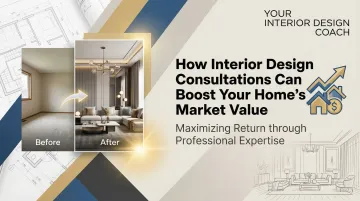
A cramped-looking living room or an awkwardly arranged bedroom can cost $10,000-$30,000 in lost value, even when the bones of the home are solid - because buyers respond emotionally to layout before they calculate logically.
Major renovations aren't always practical or cost-effective. Strategic design guidance improves marketability without breaking the bank.
This article explains the specific, measurable ways interior design consultations increase home value and speed up sales, helping you make informed decisions that deliver real returns.
Your Quick Summary
- Strategic design tweaks increase buyer appeal without expensive renovations
- Professionally styled homes sell 50% faster (23 vs. 47 days) and command 5-15% higher prices
- Consultations ($300-$1,500) deliver 10-50x ROI through faster sales and premium offers
- Prevent costly mistakes like over-personalization and poor placement that reduce appeal
What Is an Interior Design Consultation for Home Sales
An interior design consultation is a professional assessment, typically lasting 1-3 hours, where a designer evaluates your home through a buyer's lens and provides practical recommendations. Unlike full-service design or staging, consultations focus on strategic guidance that sellers can implement themselves or with minimal professional help.
During the consultation, the designer focuses on what buyers notice first:
- Layout planning that improves perceived space
- Color and finish recommendations that modernize without renovation
- Furniture placement that improves flow and highlights architectural features
- Decluttering priorities that eliminate visual obstacles
- Cost-effective updates ranked by return on investment
The goal is simple: help sellers make strategic improvements that increase marketability while staying within budget and timeline constraints.
Key Benefits of Interior Design Consultations for Home Value
Real estate data consistently shows that professionally guided homes outperform comparable properties across three measurable outcomes: faster sales, higher prices, and competitive positioning. These benefits aren't subjective; they're backed by transaction analysis across thousands of home sales.
Faster Time on Market
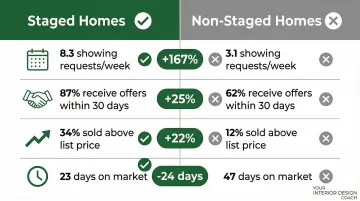
Professionally guided homes sell approximately 50% faster than non-staged properties. According to 2025 transaction data analyzing over 2,800 sales, staged homes averaged just 23 days on market compared to 47 days for non-staged homes, a 24-day advantage.
Design professionals identify and resolve visual obstacles that cause buyers to hesitate:
- Awkward layouts that make rooms feel dysfunctional - buyers feel this immediately and often can't articulate it, but they act on it by moving to the next listing
- Dated finishes that trigger mental "fix-it" calculations, which buyers subtract from their offer
- Poor lighting that makes spaces feel dark or uninviting
- Cluttered areas that prevent buyers from seeing the home's actual square footage
If you're stuck on how to prepare your home for the market, call 408-306-5003 for a free consultation - we can help you figure out which changes will actually make a difference for your specific property.
Timing of design intervention matters significantly. Homes staged before photography sold in just 19 days on average, while properties staged after 30+ days on market took 45 days to sell, more than twice as long.
These timing differences reveal a critical insight: early consultation delivers maximum impact.
When speed matters most:
- Competitive markets with high inventory
- Higher price points where buyers are more selective
- Homes with layout challenges or dated features
- Properties needing quick sales due to relocation or financial constraints
Higher Sale Prices
Design-enhanced homes command measurable premiums. 29% of real estate agents report that staging leads to a 1-10% increase in offer value, with some price bands showing even stronger returns.
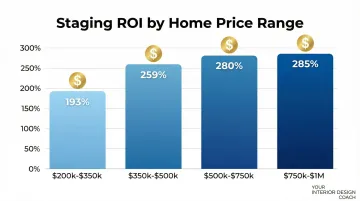
The financial impact varies by price range:
| Price Range | ROI on Staging Investment |
|---|---|
| $200k-$350k | 193% |
| $350k-$500k | 259% |
| $500k-$750k | 280% |
| $750k-$1M | 285% |
Strategic updates can deliver exceptional value, often for under $2,000. What I've seen with clients is that working with a design coach helps sellers identify which changes offer the best return. High-impact updates include:
- Paint color updates that neutralize and modernize
- Lighting upgrades that brighten and define spaces
- Furniture rearrangement that maximizes flow
- Strategic decluttering that showcases square footage
Staged homes also achieved a sale-to-list price ratio of 98.7% compared to 94.2% for non-staged homes, a 4.8-percentage-point difference that translates to thousands of dollars on a $500,000 home.
In Q1 2025, tracked staged homes sold for an average of $56,000 over list price.
ROI is highest for mid-range homes ($300k-$800k) where small design improvements significantly shift buyer perception from "needs work" to "move-in ready."
Broader Buyer Appeal
Design consultations help neutralize overly personal spaces, making homes appealing to wider buyer demographics. 83% of buyers' agents report that staging helps buyers visualize the property as a future home, the critical emotional connection that drives offers.
Broader appeal translates directly to showing traffic and competitive offers:
- Staged properties generated 8.3 showing requests per week vs. 3.1 for non-staged homes
- 40% of buyers were more willing to walk through a home they saw staged online
- 87% of staged homes received an offer within 30 days vs. 62% of non-staged properties
- 34% of staged properties sold above list price vs. just 12% of non-staged homes
The key is balancing current trends with timeless appeal. When multiple buyer segments find the same home appealing, competition builds - and competition is what drives prices above asking and strengthens the seller's negotiating position.
What Interior Design Consultations Include
Consultation deliverables vary by designer, but typically combine assessments and prioritized recommendations tailored to your home, budget, and timeline. Here's what most consultations cover:
Room-by-Room Assessment
Designers evaluate each space for layout efficiency, visual flow, lighting quality, and buyer appeal. They identify both strengths to highlight and weaknesses to address.
Priority rooms that matter most to buyers:
- Living room (91% of agents consider it essential)
- Primary bedroom (83%)
- Kitchen (68%)
- Dining room (69%)
Guest bedrooms and home offices rank lowest in staging priority, allowing sellers to focus budget where it counts.
Once the assessment is complete, designers translate findings into actionable priorities.
Strategic Improvement Priorities
Designers create prioritized action lists ranking improvements by ROI, distinguishing "must-do" changes from "nice-to-have" updates based on your budget and timeline.
Typical prioritization framework:
- Immediate impact: Changes affecting first impressions (entry, main living areas)
- High ROI: Updates that modernize without major cost (paint, lighting, hardware)
- Functional fixes: Layout improvements that resolve obvious problems
- Enhancement: Styling details that add polish after core issues are resolved
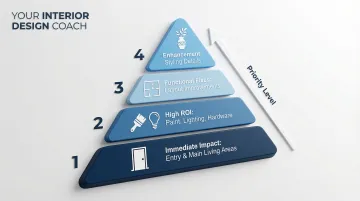
These priorities often lead directly to one of the most cost-effective improvements available.
Color and Finish Recommendations
Designers specify paint colors, flooring treatments, and finish updates that modernize spaces without expensive renovations. Color changes often deliver the highest ROI of any improvement, typically under $1,000 for most homes. What I've seen with clients is that the right neutral palette removes the "this needs work" feeling buyers get before they've even seen the full property.
Recommendations focus on neutral palettes with strategic accent opportunities that appeal broadly while avoiding bland, builder-grade monotony.
Furniture Placement and Styling Guidance
Designers create room layouts that maximize perceived space, improve traffic flow, and showcase architectural features, often using your existing furniture rather than requiring rentals.
Proper furniture placement can:
- Make a 12x14 room feel spacious instead of cramped
- Create clear traffic patterns that feel intuitive
- Highlight fireplaces, windows, or built-ins buyers might otherwise overlook
- Define purpose in multi-use spaces that confuse buyers
Working with an interior design coach provides budget-conscious guidance through each of these steps. YIDC specializes in helping sellers and real estate agents make confident design decisions that maximize home value without overspending, often using existing furniture and focusing budget on high-impact changes. If you're still feeling stuck on where to invest your preparation budget, reach out at 408-306-5003 - a free consultation can help you get unstuck and prioritize with confidence.
Common Design Mistakes That Hurt Home Value
Well-intentioned sellers often make design choices that actually reduce buyer appeal and sale prices. These are the most costly mistakes to avoid:
Over-Personalization and Bold Choices
Highly personal design elements reduce your buyer pool and trigger lower offers. Why? Buyers mentally calculate change-out costs.
These elements narrow your appeal most:
- Bold paint colors (deep reds, purples, or saturated accent walls)
- Niche decor themes (sports memorabilia, specific hobbies, strong religious imagery)
- Custom built-ins designed for specific collections or equipment
- Unusual finishes or materials that reflect individual taste
Each personalized element narrows the pool of buyers who can envision themselves in the space. When buyers see changes they'll need to make, they either walk away or reduce their offer to account for the work.
Poor Space Planning and Furniture Scale
Furniture placement matters more than most sellers realize. Oversized furniture, awkward layouts, and blocked pathways make rooms feel cramped, even when square footage is adequate.
Space planning errors include:
- Sofas blocking natural traffic flow through rooms
- Dining tables too large for the space, leaving minimal clearance
- Beds positioned to block closet access or windows
- Entertainment centers overwhelming walls and dominating rooms
Buyers form impressions within 30 seconds of entering a room. A cramped feeling triggers mental rejection, regardless of actual square footage.
Neglecting Key Buyer Priorities
Sellers often invest in low-impact updates while ignoring high-impact issues, missing opportunities for meaningful value increase.
Low-impact investments that don't move the needle:
- Decorative accessories and trendy decor items
- Expensive light fixtures in secondary spaces
- High-end window treatments
- Elaborate landscaping beyond basic curb appeal
High-impact issues that cost sales:
- Outdated lighting (especially yellow-toned or dim fixtures)
- Poor paint quality (scuffs, inconsistent coverage, dated colors)
- Dysfunctional storage that makes closets appear inadequate
- Worn flooring in high-traffic areas
Here's the difference: Investing $500 in updated lighting throughout a home can increase perceived value by $3,000-5,000. That same $500 spent on decorative accessories? Minimal impact. Buyers prioritize function, light, and modern finishes over decorative elements every time.
Maximizing ROI from Your Design Consultation
Getting a consultation is just the first step. The real market value comes from strategic implementation. These proven approaches help you convert designer recommendations into dollars when you sell:
Schedule Consultations 4-8 Weeks Before Listing
Optimal timing allows for strategic improvements without rushing and enables proper budget planning.
This timeline gives photographers and agents a polished product to market. Rushed implementations often result in incomplete work or compromised quality that undermines the entire effort.
Focus Budget on High-Impact Changes First
Apply the 80/20 rule: prioritize improvements that affect buyers' first impressions and address obvious dated elements before cosmetic updates.
Budget allocation framework:
- Entry and main living areas (40% of budget) - First impression spaces
- Primary bedroom and bath (30% of budget) - Emotional connection spaces
- Kitchen updates (20% of budget) - High-scrutiny functional space
- Secondary spaces (10% of budget) - Finishing touches only after core areas are complete
Implement Recommendations Systematically
Once you've allocated your budget, complete changes in logical sequence and document before-and-after photos for marketing purposes.
Implementation order:
- Repairs and functional fixes
- Paint and finishes
- Lighting upgrades
- Decluttering and organizing
- Furniture placement
- Styling and accessories
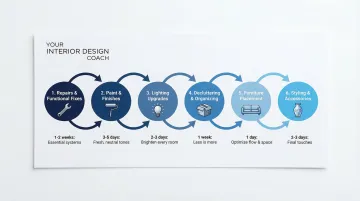
Following this sequence prevents costly mistakes. Painting after furniture placement risks damage, while styling before decluttering wastes effort on items that should be removed.
Leverage Designer Guidance for DIY Execution
Homeowners can maximize consultation value by executing recommendations themselves (painting, rearranging, decluttering) while hiring professionals only for technical work like electrical or repairs. A design coach helps you tackle DIY tasks confidently while staying within budget.
YIDC's coaching model is particularly effective for sellers who need expert guidance without full-service costs. This approach helps you get unstuck on decision-making while maintaining budget control.
You'll build confidence in your choices throughout the selling process, ensuring each improvement actually contributes to market value.
When to Get a Design Consultation Before Selling
Most sellers benefit from booking a consultation 6-12 weeks before listing. This window provides enough time to assess the space, plan changes, and implement recommendations before photography.
Schedule earlier consultations (8-12 weeks out) when you need:
- Your home needs significant decluttering or organizing
- Creative solutions for layout challenges or awkward spaces
- Help determining which renovations deliver the best ROI
- Coordination support for multiple contractors
Last-minute consultations (1-2 weeks out) still deliver value for:
- Quick-win recommendations like furniture rearrangement
- Strategic lighting changes that improve photography
- Focused decluttering guidance for high-impact areas
- Rapid paint color decisions for key rooms
The difference maker: Acting on recommendations completely. Partial changes often confuse buyers rather than attract them, while focused improvements in priority areas consistently drive higher offers.
Your Quick Recap
Interior design consultations work because they close the gap between what a seller sees and what a buyer sees. Sellers are emotionally attached to the space; buyers are making a business decision in thirty seconds. A consultation translates the seller's vision into the buyer's language.
- First impressions form within 8 seconds - the entry and main living area determine the outcome
- Staged homes generate more showings; more showings create competition; competition drives price up
- The consultation's job is to neutralize the space, not decorate it
- Budget on ROI: the highest-return changes are often paint and lighting, not renovations
- Consulting 6-8 weeks before listing gives time to implement without rushing quality (bonus insight)
- A consultation fee is typically recovered in the first week of faster carrying-cost savings alone (bonus insight)
If you're still feeling stuck and haven't been able to move things forward, let's talk! Reach out for a free consultation at 408-306-5003, and we can take it from there.
Frequently Asked Questions
How does home design consultation help in real estate sales?
Design consultations identify strategic improvements that increase buyer appeal. Professionally guided homes typically sell 50% faster and command 5-15% higher prices for modest investment.
Is a design consultation worth the cost when selling my home?
Consultations typically cost $300-$1,500 and return 10-50x that investment through higher sale prices and reduced carrying costs. For mid-range homes, few investments offer better returns.
What's the difference between a design consultation and home staging?
Consultations provide strategic guidance you implement yourself, while staging involves renting furniture and decor for temporary display. Consultations cost less and can inform staging decisions if you choose that route later.
Can I stage my home myself after getting a consultation?
Most sellers successfully implement recommendations for painting, decluttering, furniture rearrangement, and styling themselves. This approach saves thousands compared to full-service staging while achieving similar results.
When should I schedule a design consultation before listing my home?
Schedule 6-8 weeks before listing to allow time for improvements. Even last-minute consultations help by identifying simple changes that improve photography and showing appeal.
How much value does professional design guidance add to a home sale?
Professionally designed homes typically sell for 5-15% more than comparable properties. The highest returns appear in mid-range homes ($300k-$800k) where targeted improvements significantly shift buyer perception.