Have you ever walked into a room that just feels "off"? The furniture is beautiful, the colors are perfect, but something doesn't work. You bump into the coffee table constantly, dining chairs won't pull out without hitting the wall, or the room feels cramped despite being spacious.
Space planning is the invisible foundation that separates rooms that look good in photos from spaces that actually feel good to live in. It's the first step that happens before you pick paint colors, shop for furniture, or hang artwork.
Research shows that space design is the most influential factor on occupants' overall satisfaction with their indoor environment, more than color, lighting, or décor.
Yet poor planning remains a costly problem. Design errors average 14.2% of original contract value in construction projects, often stemming from inadequate space planning.
Poor planning leads to:
- Buying furniture that doesn't fit
- Creating awkward traffic flow
- Missing opportunities to maximize your space's potential
Your Quick Summary
- Analyzes room usage to maximize functionality, comfort, and flow
- Creates zones for activities while ensuring smooth traffic patterns
- Prevents costly furniture mistakes and daily frustrations
- Achievable as a DIY project or with coaching support to build confidence
What Is Space Planning and Why It Matters for Your Home
Space planning is the strategic process of analyzing how you'll use a space and creating a layout that supports your daily activities, movement patterns, and lifestyle needs.
It's part science: measurements, ergonomics, building codes; and part art: flow, balance, visual harmony.
Why Function Trumps Aesthetics
A beautifully decorated room that doesn't function well frustrates you every day - and that frustration is cumulative. Space planning ensures your home actively supports your life rather than working against it. When the layout works, you stop noticing it - the room just does what it should, every single time.
Studies reveal that 63% of the variance in safety injuries on construction projects stem from rework caused by design errors - the same logic applies residentially: poor planning creates problems that cost more to fix than to prevent.
Common complaints include insufficient storage, kitchens with inadequate workspace, and rooms where furniture placement creates constant navigation obstacles. These aren't aesthetic failures; they're functional ones that proper space planning prevents.
Space Planning vs. Interior Decorating
Space planning focuses on function: how people move through spaces, where furniture should be positioned for optimal use, and how different zones relate to each other. Interior decorating adds personality through colors, textures, and accessories. You need the functional foundation first.
Space planning determines that your sofa should be 8 feet from your TV for comfortable viewing and positioned to avoid blocking the walkway to the kitchen. Decorating decides whether that sofa is gray velvet or blue linen.
Beyond New Construction
Many people think space planning is only necessary for new construction or major renovations. In reality, it's valuable for any space you want to function better.
Space planning helps when you're
- Moving into a new place and deciding where the furniture should go
- Feeling frustrated with the way your current layout works
- Planning a renovation or furniture purchase and wanting fewer expensive mistakes
Whether you're overwhelmed by design choices or tired of a room not working the way it should, space planning gives you a better place to start.
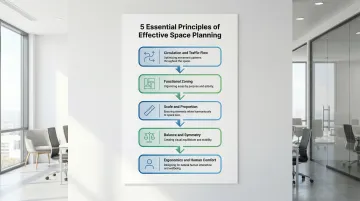
The 5 Essential Principles of Effective Space Planning
Circulation and Traffic Flow
Circulation refers to the paths people take moving through a space. Good circulation feels natural and unobstructed; poor circulation creates the kind of low-level daily friction that makes a home feel exhausting without an obvious reason.
Key measurements to follow:
- Major walkways: minimum 36 inches wide
- Secondary paths: minimum 30 inches wide
- Hallways: minimum 3 feet (36 inches) per building codes - when hallways meet this standard, moving through your home stops requiring any conscious thought
- Doorways: 32-inch clear opening minimum, 34 inches for accessibility
Trace common routes on your floor plan, entry to kitchen, kitchen to dining room, bedroom to bathroom. Identify where paths cross through functional zones.
The goal is designing circulation that doesn't cut through activity areas, like a main walkway going right through your living room conversation space.
Functional Zoning
Once you've mapped circulation paths, the next step is defining how each area will be used. Zoning assigns specific areas within a space for particular activities. This is especially critical in open-concept homes but applies to any room.
Examples of effective zoning:
- Living room: conversation zone (seating arrangement), media zone (TV viewing), reading zone (chair with good lighting)
- Open kitchen-living space: distinct cooking, dining, and lounging areas that don't feel chaotic
- Home office: focused work zone, video call zone, storage zone
Techniques for defining zones without walls:
- Furniture arrangement and orientation
- Area rugs that anchor specific areas
- Lighting changes (pendant lights, floor lamps)
- Different ceiling heights or architectural details
- Partial dividers like bookcases or screens
Scale and Proportion
Getting the size right is crucial. Scale is the relationship between objects and the space they occupy: a sectional perfect for a large family room will overwhelm a small apartment and block the pathways you need to live comfortably. Proportion is the relationship between pieces: a large sofa needs a coffee table proportional to it, or the whole grouping reads as unintentional.
Practical guidance:
- Measure your room before shopping for furniture
- Create a scaled floor plan on graph paper (¼ inch = 1 foot) or use digital tools
- Cut out scaled furniture shapes to test arrangements before purchasing
- Consider visual weight: solid wood feels heavier than glass, dark colors heavier than light
Balance and Symmetry
Beyond choosing the right sizes, you need to distribute them thoughtfully. How you distribute visual weight affects how comfortable a room feels. A room with all heavy furniture on one side feels unbalanced, even if you can't articulate why.
Two approaches to balance:
- Symmetrical arrangements (matching sofas facing each other) create formal, calm spaces
- Asymmetrical balance (different pieces with equivalent visual weight) feels more casual and dynamic
Achieve balance by considering the visual weight of furniture, color (dark colors feel heavier), and placement relative to the room's focal point. Distribute elements around the room so no area feels too heavy or too empty.
Ergonomics and Human Comfort
The final principle ensures your beautifully planned space actually works for daily life. Ergonomics in interior design means creating spaces that fit human needs and movements: appropriate heights for counters and tables, adequate space to open doors and drawers, and comfortable reach distances.
Key ergonomic measurements:
- Dining chairs: 24-30 inches of space to pull out
- Kitchen work triangle: 12-26 feet total
- Desk chairs: 36 inches of push-back space
- Work surface heights: 28-34 inches for accessibility
- Monitor placement: 20-39 inches from eyes
Good ergonomics is invisible; you don't notice it until it's missing. When a space is ergonomically sound, everything feels right and requires no extra thought or effort.
These five principles work together to create spaces that are both beautiful and functional. Master them, and you'll have the foundation for confident design decisions in any room.
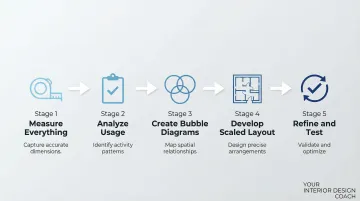
Your Step-by-Step Space Planning Process
Step 1: Measure Everything and Document Existing Conditions
Start with accurate measurements of your space: length, width, and ceiling height. Then document all permanent features:
- Doors and their swing direction
- Windows and their sizes
- Electrical outlets and light switches
- HVAC vents and radiators
- Built-ins and architectural features like fireplaces or columns
Observe conditions:
- Where does natural light come from and when?
- Are there views to preserve or block?
- What are the flooring materials?
- Are there structural issues, odd angles, or quirks to work around?
Create a floor plan on graph paper using a scale like ¼ inch = 1 foot, use free online tools, or hire someone to create one. This becomes your working document.
Step 2: Analyze How You'll Actually Use the Space
Think deeply about how this space will function day-to-day. Ask yourself:
- Who uses this space and when?
- What specific activities happen here?
- How many people need to use it simultaneously?
- What are priority activities versus occasional ones?
Observe current habits:
- Where do you naturally gravitate?
- Where do things pile up?
- What frustrates you about the current setup?
These observations reveal what your space truly needs. Create an activity list for each space, a home office might need focused computer work, video calls, filing/storage, and occasional client meetings. This prevents overlooking important functions.
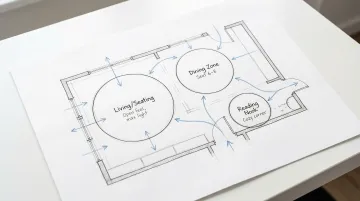
Step 3: Create Bubble Diagrams to Explore Zone Relationships
Bubble diagrams are flexible brainstorming tools that help you explore possibilities. Draw rough circles representing different activity zones and experiment with how they relate to each other spatially. This is abstract, not to scale yet.
Consider:
- Which zones need to be adjacent?
- Which should be separate?
- How does each zone relate to entry points, windows, and fixed features?
- What's the logical sequence of movement?
Create multiple bubble diagrams exploring different arrangements. This is where you discover possibilities you hadn't considered and identify the most promising direction before committing to specific furniture.
Step 4: Develop a Scaled Furniture Layout
Translate your best bubble diagram into a scaled floor plan with actual furniture dimensions. Measure existing furniture you plan to keep, or research dimensions of pieces you're considering; precision matters here.
Two effective methods:
Paper cutout method:
- Cut scaled furniture shapes from paper
- Arrange them on your floor plan
- Easily experiment with different configurations
Painter's tape method:
- Use painter's tape on your floor to outline where major pieces will go
- Walk through it, sit where chairs would be
- Test if the layout truly works in three dimensions
Step 5: Refine, Test Traffic Flow, and Iterate
Trace circulation paths on your plan. Draw lines showing how people will move from entry points to each functional zone. Look for problems:
- Do any paths cut through activity areas?
- Are there bottlenecks?
- Is any route unnecessarily long?
Physical testing:
- Actually walk the routes in your taped-out space
- Can you comfortably pass by furniture?
- Can you pull out chairs without hitting anything?
- Does the flow feel natural or forced?
Your first layout is rarely your final one. Be willing to adjust, swap pieces, or rethink your approach if something doesn't work. Each iteration gets you closer to the optimal solution.
Common Space Planning Mistakes (and How to Avoid Them)
Many people fall in love with a sofa and buy it, only to discover it doesn't fit or work with their layout. Use your scaled floor plan to determine what size and shape furniture you need before browsing - purchasing first then planning is the most common and most expensive mistake in residential design.
Furniture might technically fit but still create awkward navigation. Verify that major pathways are at least 36 inches wide and that you can open doors, pull out chairs, and access storage without obstacles. Professional standards require 42-48 inches for kitchen work aisles to prevent bottlenecks.
Pushing all furniture against walls is common in small spaces, but floating pieces away from walls creates better conversation areas and actually makes the space feel larger - because depth is more readable than perimeter.
Practical Space Planning Guidelines by Room Type
Living Room Essentials
Key measurements:
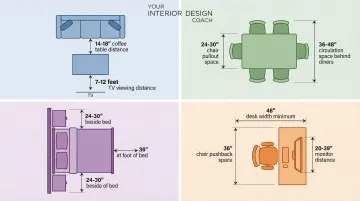
- Coffee table: 14-18 inches from seating
- Seating pieces: 30-36 inches apart for conversation
- TV viewing distance: 1.5-2.5 times the screen diagonal size (7-12 feet for a 50-inch TV)
Common layouts:
- Symmetrical arrangement around a fireplace for formal spaces
- L-shaped sectional for open concepts that need defined zones
- Floating conversation area in large rooms to create a cozy feel
Dining Room and Kitchen Spacing
Critical clearances:
- Dining chairs: 24-30 inches from table edge to wall/furniture for pulling out
- Ideal dining circulation: 36-48 inches behind seated diners
- Kitchen work triangle: 12-26 feet total, each leg 4-9 feet
- Kitchen work aisles: 42 inches minimum for single cook, 48 inches for multiple cooks
Layout strategy:
Position tables relative to kitchen entries ensuring serving paths stay clear. Create a comfortable relationship between cooking and eating zones by maintaining sight lines and minimizing the distance servers must carry dishes.
Bedroom Layout Principles
Bed placement:
- Usually the focal point, visible from entry but not directly in line with the door
- Allow 24-30 inches on each side for getting in/out comfortably
- 36 inches at the foot for circulation
Storage and dressing areas:
- Position dressers and closets where drawers and doors can open fully
- Ensure adequate space (minimum 36 inches) in front of closets
- Create a functional getting-ready zone near natural light if possible
Home Office and Multi-Functional Spaces
Home office essentials:
- Desk: minimum 48 inches wide work surface
- Proper lighting: natural light to the side, not behind you creating glare
- 36 inches of push-back space for the chair
- Monitor 20-39 inches from eyes
Multi-functional planning:
When a space serves multiple purposes (guest room + office, living room + play area), create clear zones for each function.
Consider furniture that adapts:
- Murphy beds for guest room/office combinations
- Fold-away desks that disappear when not in use
- Storage ottomans that double as seating
If you’re stuck trying to make dual-purpose spaces work for your specific needs, I can help you figure out where the layout is breaking down and what needs to change first. Reach out for a free consultation at 408-306-5003, and we can take it from there.
When to Call in a Space Planning Coach
After almost 20 years in interior design, I’ve seen that most people do not necessarily need someone to take over every design decision for them. What often helps more is having an experienced eye to point out what may not be working, ask the right questions early, and make the overall process feel less overwhelming and more intentional.
That is the difference between traditional interior design and design coaching. Instead of doing everything for you, I help guide you through decisions with professional input, practical direction, and a clearer understanding of how the space can work better.
When Coaching Helps Most
Coaching can be especially valuable when:
- You need a fresh perspective on a layout or space that no longer feels functional
- You want clarity before investing in furniture, finishes, or larger design decisions
- You need professional space planning drawings to help move a project forward smoothly
- You want to work with the furniture, layout, or budget you already have instead of starting from scratch
Whether it is a single consultation to bring clarity to a space or ongoing support through a larger project, coaching is designed to meet you where you are and help you move forward with more confidence.
If you’ve been sitting with ideas but still feel unsure about the next step, sometimes a quick conversation can bring a lot of clarity. You can reach out for a free consultation at 408-306-5003 or book it here. We can talk through your space, your goals, and where to go from here!
Your Quick Recap
Space planning is the one design decision that affects every other design decision you make. Get the layout wrong and no amount of great furniture or beautiful color will fix the daily friction. Get it right and even modest, budget-friendly choices feel intentional and comfortable. The sequence is what matters most.
- Layout is the foundation; decoration is the finish coat - you need the foundation solid first
- Scale and proportion errors are the most expensive mistakes because they require either returns or rearrangement
- Circulation paths are not just about walking - they are about how relaxed or stressed people feel daily
- Testing with painter's tape costs nothing and prevents furniture mistakes that cost hundreds
- The bubble diagram step - rough zone sketching before scale drawing - is the step most people skip and then regret (bonus insight)
- For contractors and real estate agents, presenting a clear space plan to clients dramatically shortens the decision-making process (bonus insight)
If you're still feeling stuck and haven't been able to move things forward, let's talk! Reach out for a free consultation at 408-306-5003, and we can take it from there.
Frequently Asked Questions
What is the difference between space planning and interior design?
Space planning focuses specifically on functional layout: organizing spaces, traffic flow, and furniture placement. Interior design encompasses space planning plus aesthetic elements like color, materials, lighting, and décor.
Can I do space planning myself or do I need a professional?
Simple spaces can be planned using basic tools like scaled floor plans and paper cutouts. Professional help becomes valuable for complex layouts, when you're stuck, or when you need expert validation before making expensive purchases.
What are the biggest space planning mistakes to avoid?
Top mistakes include buying furniture before planning the layout, ignoring traffic flow and clearances, choosing wrong-scale pieces, and not considering how you actually use the space daily versus how you think you should.
How long does the space planning process take?
A single room typically requires a few hours of measuring and research, plus one to two weeks of layout experimentation. Whole-house projects or major renovations often take several weeks of work and iteration.
What measurements do I need to take before space planning?
Essential measurements include room dimensions, door and window locations with swing directions, electrical outlets, HVAC vents, permanent fixtures, architectural quirks (columns, angled walls), and any existing furniture you're keeping.
How do I know if my furniture will fit before I buy it?
Create a scaled floor plan to test dimensions, then use painter's tape on your actual floor to outline the footprint. Verify it leaves adequate clearance for traffic, other furniture, and that doors and drawers can open fully.