Your challenge isn't square footage: it's how you're using what you have.
Strategic space planning solves this by making your space work harder - not bigger. It's the systematic process of analyzing, organizing, and arranging your physical environment to meet your functional needs, aesthetic goals, and lifestyle requirements.
From my experience, most of the time, it’s not about needing more square footage. It’s about understanding how each room works best for your lifestyle. When a room’s layout is spot on, everything just clicks.
In this guide, you'll learn what strategic space planning is, why it matters, the step-by-step process to use it, and the common mistakes to avoid. You'll see how to find hidden potential in every square foot.
Your Quick Summary
- Optimize layout and flow before buying furniture or decorating
- Boost property value up to 10% and cut market time nearly in half
- Follow a clear process: assess, define goals, analyze constraints, test layouts
- Avoid buying furniture first, ignoring scale, or neglecting storage
- Get professional coaching when stuck or facing complex challenges
What is Strategic Space Planning?
Strategic space planning is the systematic process of analyzing, organizing, and arranging physical spaces to meet specific functional, aesthetic, and lifestyle goals - before choosing a sofa, a paint color, or anything else.
The Council for Interior Design Qualification defines it as "organizing interior layouts to support functionality and safety" - a discipline focused on how spaces work, not just how they look.
The Critical Distinction from Interior Design
Space planning and interior design are related but distinct:
- Space planning focuses on layout, flow, and functionality first, determining where furniture goes, how traffic moves, and whether activities can happen efficiently
- Interior design includes broader aesthetics including colors, finishes, styling, and the overall sensory experience
Think of space planning as the structural backbone. You wouldn't paint walls before framing them; similarly, effective design requires functional layout before aesthetic decisions.
According to the American Society of Interior Designers, design must "meet the requirements of the end user and improve the human experience," which starts with proper spatial organization.
Application Across Property Types
Different property types require tailored approaches:
- Primary residences: Optimize daily routines, accommodate family growth, and create zones for work, rest, and play
- Rental properties: Balance durability with appeal, maximize perceived value, and create layouts that photograph well for listings
- Airbnb/Vrbo spaces: Design for guest comfort, intuitive navigation for first-time visitors, and competitive differentiation in local markets
- Properties staged for sale: Highlight square footage, create aspirational lifestyle vignettes, and help buyers visualize themselves living there
Core Principles That Drive Results
Purpose matters more than square footage. A 2,000-square-foot home with poor layout will feel smaller and function worse than a 1,400-square-foot home with strategic organization.
Future flexibility is equally important. Your needs will evolve: growing families, aging in place, remote work transitions, or lifestyle changes. Smart layouts accommodate these shifts without requiring major renovations.
This means incorporating adaptable furniture, multi-purpose rooms, and flexible zones that can transition as your life does.
Key Benefits of Strategic Space Planning for Your Home or Property
Improved Functionality and Workflow
Proper space planning eliminates wasted movement and creates intuitive traffic patterns. In kitchens, the National Kitchen & Bath Association recommends the work triangle (sink, cooktop, refrigerator) total no more than 26 feet, with no single leg less than 4 feet or more than 9 feet.
This standard reduces unnecessary steps during meal preparation, saving time and physical effort daily. When the kitchen triangle is calibrated correctly, cooking stops feeling like a chore that requires walking back and forth and becomes something you can actually move through efficiently.
Beyond kitchens, strategic planning ensures:
- Clear pathways that don't cross through activity zones
- Related functions positioned near each other (laundry near bedrooms, office away from high-traffic areas)
- Adequate clearances (minimum 36" for walkways, 42-48" for work aisles)
Increased Property Value
Well-planned spaces deliver measurable financial returns. According to the National Association of Realtors, staging, which includes layout planning, produced significant results:
- 49% of seller's agents reported staging reduced time on market
- 29% of agents saw a 1-10% increase in dollar value offered
- 83% of buyer's agents said staging made it easier for buyers to visualize the property as their future home
I can tell you, from working with clients, the first time they realize how much their layout impacts their daily life, it’s like a lightbulb goes off. Once the layout starts working for them, everything else falls into place.
If you’re feeling stuck or unsure how to make the most of your space, I can help you identify where your layout needs adjustment. Reach out for a free consultation at 408-306-5003, let’s talk about it!
Better Space Utilization
Strategic planning uncovers "hidden" square footage you didn't know you had. Dead zones (those awkward corners, underutilized hallways, or poorly configured rooms) represent wasted potential.
Through careful analysis, these areas transform into functional storage, reading nooks, or workspace that makes the entire home feel larger.
Proper planning prevents common mistakes like blocking natural light with furniture, creating bottlenecks in high-traffic areas, or dedicating entire rooms to single purposes when multi-functional design serves better.
Enhanced Comfort and Well-Being
Research published in the National Institutes of Health demonstrates that access to daylight improves circadian alignment, sleep quality, and mental health. Strategic space planning maximizes natural light penetration through thoughtful furniture placement and window treatment choices.
Additional well-being benefits include:
- Studies show that maze-like designs and lack of privacy link to higher stress, while layouts encouraging movement and social interaction support mental health
- Dedicated zones for specific activities (work, relaxation, family time) help your brain associate spaces with their intended functions
- Proper ergonomics and clearances reduce strain and prevent accidents
Cost Savings Over Time
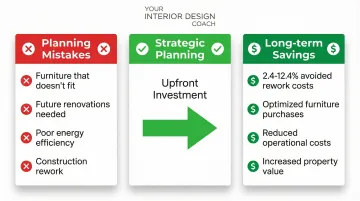
Planning prevents expensive mistakes. In construction projects, research shows that rework costs range from 2.4% to 12.4% of contract value, expenses directly caused by design changes and planning errors.
Upfront planning delivers additional savings:
- Prevents buying furniture that doesn't fit or serve the space
- Reduces future renovation needs by getting layouts right initially
- Lowers operational costs through strategic placement of heating/cooling zones and natural light use
- Eliminates costly change orders during construction
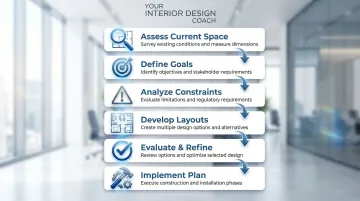
The Strategic Space Planning Process: A Step-by-Step Guide
Step 1: Assess Your Current Space
Begin with accurate documentation:
Measure precisely: Record room dimensions, door widths (minimum 32" clear opening), window locations, and ceiling heights. Note existing features like radiators, outlets, and built-ins.
Inventory conditions: Document what exists: flooring, lighting, storage, architectural details. Take photos from multiple angles.
Identify pain points: Where does the space fail you? Common issues include inadequate storage, poor traffic flow, insufficient lighting, or rooms that don't serve their intended purpose.
Recognize what works: Not everything needs changing. Identify successful elements to preserve or build upon.
Step 2: Define Your Goals and Requirements
Define specific needs through these questions:
- Who uses the space? Adults, children, guests, pets: each has different requirements
- What activities occur here? Cooking, working, entertaining, sleeping, storage
- What storage do you need? The NKBA recommends 1400-2000 inches of shelf frontage for kitchens based on size
- What's your aesthetic preference? Modern, traditional, minimalist, eclectic
- What's your budget? Establish realistic financial parameters upfront - knowing this before you begin means your decisions stay grounded in what's achievable, not what requires starting over later
Step 3: Analyze Space Constraints and Opportunities
Evaluate structural realities:
Limitations: Load-bearing walls, plumbing locations, electrical panels, HVAC vents, window placement, door swings
Opportunities: Natural light sources, architectural features worth highlighting, underutilized areas, flexible walls or partitions
Traffic patterns: Map how people move through the space. High-traffic routes need minimum 36" clearance and shouldn't cross work zones.
Step 4: Develop Layout Options
With your constraints mapped, create multiple layout scenarios:
- Furniture placement: Position major pieces first, ensuring proper clearances (32" to walk past seating, 44" to pass behind someone seated)
- Activity zones: Group related functions like conversation areas, work zones, and storage
- Circulation paths: Maintain clear walkways that don't force awkward navigation
Test layouts using graph paper, digital floor plan software, or painter's tape on floors to visualize options before committing. An interior design coach can help you evaluate which scenarios best meet your goals.
Step 5: Evaluate and Refine
Compare options against your goals:
- Does this layout support all required activities?
- Are clearances adequate for comfortable movement?
- Does traffic flow logically without crossing work zones?
- Does the plan include sufficient storage?
- Does the layout maximize natural light?
Gather feedback from everyone who uses the space. Live with temporary arrangements using existing furniture before making permanent changes.
Step 6: Implement Your Plan
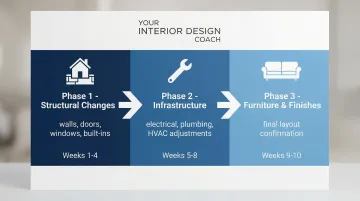
Execute in phases if needed:
- Structural changes first: Walls, doors, windows, built-ins
- Infrastructure next: Electrical, plumbing, HVAC adjustments
- Furniture and finishes last: Once the layout is confirmed
Coordinate with contractors, maintain flexibility for field adjustments, and document decisions to avoid scope creep.
Essential Elements to Consider in Space Planning
Functional Zones and Their Relationships
Organize spaces based on activity relationships:
- Kitchen near dining reduces serving distance and facilitates entertaining
- Home office positioned away from noise separates focused work from household activity
- Bedrooms distant from living areas provide privacy and sound separation
- Mudroom near entry contains mess before it spreads through the home
The NKBA's work triangle principle applies beyond kitchens: related functions should be close but not overlapping, with no full-height obstacles separating primary work centers.
Traffic Flow and Circulation
Clear pathways are non-negotiable:
- Walkways need at least 36" for one person (42" where two walkways intersect)
- Work aisles require 42" minimum, expanding to 48" when multiple people share the space
- High-traffic routes must avoid narrowing or forcing awkward navigation
Avoid layouts where major circulation crosses through activity zones. Someone walking to the bathroom shouldn't disrupt someone cooking or working.
Flexibility and Adaptability
Plan for change:
- Guest rooms that function as offices, dining areas that accommodate work, living rooms with flexible seating arrangements
- Furniture on casters, folding tables, and modular storage systems that adapt to changing needs
- Wider doorways (34" recommended), no-step entries, and lever handles that accommodate aging in place and diverse abilities
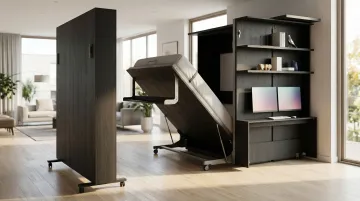
A 2024 study on movable interior systems shows that retractable beds and dynamic partitions enable single rooms to transition between bedroom, workspace, and social lounge, maximizing efficiency without structural expansion.
When planning flexible spaces, consider working with an interior design coach who can help you identify which multi-purpose strategies fit your specific lifestyle and budget constraints.
Common Space Planning Mistakes to Avoid
Furniture-First Approach
Buying furniture before planning the layout is the most common and most expensive mistake. That sofa might look perfect in the showroom but block your main walkway at home - and returning oversized furniture costs time, delivery fees, and often a restocking charge.
Plan the layout first, then shop:
- Measure activity zones and ensure proper clearances
- Select furniture sized appropriately for the space
- Follow NKBA requirements for 30" x 48" clear floor space at activity centers
- Let space needs dictate furniture choices, not the reverse
Ignoring Scale and Proportion
Oversized furniture makes rooms feel cramped; undersized pieces look lost and fail to anchor spaces properly.
Apply these scale principles:
- Use the one-third rule: sofas should occupy roughly one-third of wall length
- Maintain visual balance by varying heights and masses
- Test scale using templates or digital tools before purchasing
Over the years, I’ve learned that the key to successful space planning is always starting with the bigger picture. Once you have your layout right, the furniture follows naturally. This is something I repeat often to my clients.
Neglecting Storage Needs
Inadequate storage leads to visible clutter, which 91% of real estate agents identify as the top issue reducing buyer appeal.
Calculate storage requirements during planning. The NKBA provides specific guidelines: 1400-2000 inches of shelf frontage for kitchens based on size.
Incorporate storage from the start:
- Built-ins and closet systems
- Furniture with integrated storage
- Vertical wall solutions
- Custom cabinetry in awkward spaces
How YIDC Helps You Avoid These Pitfalls
YIDC's interior design coaching helps clients work through these challenges by asking the questions they didn't know to ask. With almost 20 years of experience, founder Miriam Saadati guides clients through the decision-making process. If you've been feeling stuck and haven't been able to move things forward, reach out for a free consultation at 408-306-5003 - we can take it from there.
Whether you need space planning for a single room or an entire property, YIDC provides expert guidance when you're stuck, helps you work with existing furniture, and walks you through from initial assessment to final implementation.
Your Quick Recap
Strategic space planning is one of those things that feels abstract until you live in a space that has it - and then you immediately notice when a new space does not. The work happens before the furniture arrives, not after. That sequence is what separates homes that function from ones that just look good in photos.
- Layout and flow come before colors and finishes - always plan the structure first
- A well-planned 1,400 sq ft home functions better than a poorly planned 2,000 sq ft one
- Traffic patterns are not just about walking - they are about how your daily routine actually moves
- Defining zones without walls is a learnable skill; rugs, lighting, and furniture do the work
- Space planning is the one change that affects how a home sells - buyers feel good layouts without knowing why
- For rental properties, a layout that photographs well and functions intuitively directly increases your review score
If you're still feeling stuck and haven't been able to move things forward, let's talk! Reach out for a free consultation at 408-306-5003, and we can take it from there.
Frequently Asked Questions
What is strategic space planning?
Strategic space planning intentionally organizes physical space to maximize functionality and align with how you actually use it. It prioritizes layout and flow before aesthetics or furniture selection.
How do I start planning my space layout?
Measure your space accurately, list all activities that occur there, and identify current pain points. Documenting what's not working ensures your layout solves real problems rather than creating new ones.
What's the difference between space planning and interior design?
Space planning focuses on layout and functionality: where things go and why. Interior design encompasses broader aesthetics like colors, finishes, and styling. Effective design requires functional planning first.
Can I do space planning myself or should I hire a professional?
Simple single-room projects can be DIY with measuring tools, floor plan software, and research. Complex layouts, structural changes, or situations where you feel stuck benefit from professional guidance; interior design coaches like YIDC help you get unstuck while building confidence in the process.
How long does a space planning project typically take?
Timelines vary from a few days for single-room planning to several weeks for whole-home projects. According to design professionals, complexity, decision-making pace, and whether structural changes are involved significantly impact duration. Planning phases generally take 2-8 weeks before implementation begins.
What tools do I need for basic space planning?
Essential tools include a measuring tape, graph paper or digital floor plan software (many free options available), furniture templates or cutouts scaled to your drawings, and photos of the existing space. These allow you to test multiple layout options before moving physical furniture.