Privacy disappears, creating what designers call the "airport effect" (that exposed, unsettled feeling of being constantly on display). Without walls acting as natural dividers, even simple things like defining zones, managing clutter, or arranging furniture can become surprisingly tricky.
The good news is that open layouts do not have to feel chaotic or impersonal. With the right design strategies, you can keep the airy openness people love while still creating spaces that feel functional, grounded, and comfortable to live in.
This guide walks you through practical strategies for open space design. You'll learn how to define zones without walls, manage acoustics, handle visual flow, and arrange furniture effectively, all while keeping the airy openness that makes these layouts so appealing.
Your Quick Summary
- Define zones with furniture, rugs, and lighting, not physical barriers
- Control noise with soft furnishings that absorb sound hard surfaces amplify
- Maintain visual cohesion through a unified color palette while using subtle variations to distinguish zones
- Create psychological comfort by establishing "micro-rooms" that provide refuge from constant openness
- Plan traffic flow with minimum 36-inch walkways and proper furniture clearances before purchasing pieces
Understanding Open Space Design: Is It Right for You?
Open space design joins two or more common areas (typically kitchen, dining, and living rooms) into a larger communal space by eliminating partition walls. This differs from semi-open layouts that retain partial walls or doorways between areas.
The lifestyle benefits are compelling:
- Parents can supervise children while cooking or interact with guests during meal preparation
- Removing walls allows natural light to penetrate deeper into the home, brightening previously dim spaces
- Perceived spaciousness: Continuous sightlines make homes feel larger than their actual square footage
- Hosts move freely between kitchen and gathering spaces when entertaining
If you're stuck deciding whether an open floor plan is right for your home or how to approach the design challenges, call 408-306-5003 for a free consultation - we can help you think through the trade-offs and identify the right path forward.
When open spaces work best:
Open concepts excel for families who prioritize togetherness, households that entertain frequently, and homes with scenic views to enjoy from multiple vantage points.
86% of buyers prefer open kitchen-dining arrangements, confirming their alignment with modern lifestyle preferences.
When traditional layouts work better:
Traditional layouts with defined rooms may serve you better if:
- Multiple household members work from home and need quiet spaces
- Family members have conflicting schedules requiring sound separation
- You're highly sensitive to visual clutter and prefer enclosed spaces
5 Key Challenges in Open Space Design (And Why They Matter)
Privacy Concerns
In my experience, privacy problems usually show up in small ways first: the work call happening beside the kitchen, the TV competing with dinner cleanup, or the feeling that there is nowhere quiet to step away.
Constant openness can feel overwhelming, creating what designers call the "airport effect": that exposed, unsettled sensation of lacking refuge.
Humans need retreat spaces. The inability to escape into a separate room for solitude or concentration can create mental fatigue over time, making noise management the next critical challenge.
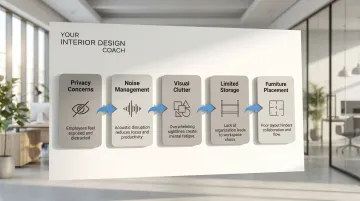
Noise Management
Sound travels unobstructed in open plans, creating constant audio conflicts:
- Dishwasher cycles compete with television audio
- Cooking sounds interrupt homework sessions
- Phone conversations lack privacy
- Work calls clash with family activities
Hard surfaces common in modern design amplify the problem. Materials like tile floors, stone countertops, and glass backsplashes increase echo rather than absorbing sound.
The result is reduced speech intelligibility and a constant background noise level that many find stressful.
Visual Clutter and Cohesion
In open sightlines, clutter appears in your peripheral vision regardless of where you stand:
- Dirty dishes in the kitchen visible from the living room
- Toys scattered in the dining area intruding on relaxation time
- Paperwork and mail cluttering countertops seen from every angle
There's simply nowhere to hide everyday mess.
Beyond clutter, maintaining consistent style across multiple functional zones proves challenging. What works aesthetically in a kitchen may clash with living room furnishings when both spaces are visually connected.
Limited Storage and Wall Space
Eliminating partition walls removes valuable vertical real estate for storage, reducing opportunities for upper cabinets, closets, and built-in shelving. Items traditionally hidden in closets or pantries must find new homes, often on visible surfaces, contributing to the clutter problem.
Furniture Placement Complexity
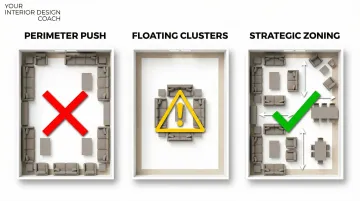
Arranging furniture without walls as natural anchors creates unique challenges. How do you define a conversation area when there's no corner to anchor it? Where does the living zone end and the dining zone begin? Poorly placed furniture either creates a "giant hall" effect with everything pushed to the perimeter, or obstructs traffic flow when pieces float awkwardly in the middle.
Strategic planning becomes essential to create comfortable conversation areas, establish clear pathways, and define zones without physical barriers.
8 Expert Tips for Mastering Open Space Interiors
Create Distinct Activity Zones Through Strategic Planning
When I design an open floor plan, I first think about how the space actually needs to function on a daily basis. Instead of treating it like one large empty area, I focus on creating intentional zones that feel naturally connected while still serving different purposes. I pay attention to movement patterns, conversation areas, quieter corners, and how people transition between activities, since that’s what ultimately makes an open layout feel cohesive rather than chaotic.
You can consider:
- How many people typically gather in your living area?
- Do you host dinner parties requiring a large dining table, or is it primarily for family meals?
- Will anyone work in this space?
Allocate square footage according to real needs, not aspirational activities. If you rarely entertain formally, prioritize everyday living space over an oversized dining area. Getting this right means the layout supports how you actually live instead of how you imagined you might, which is what makes open spaces feel genuinely comfortable rather than just large.
Use Furniture as Architectural Elements
Strategic furniture placement creates boundaries without blocking sightlines or light.
The sofa as divider: Position your sofa with its back to the dining area or kitchen. This creates a psychological boundary between zones while maintaining openness.
The sofa back acts as a "soft wall" that defines the living space without requiring physical barriers.
Open shelving units allow light to pass through while creating beautiful partial dividers. Place a bookcase perpendicular to a wall to separate a home office nook from the main living area.
Console tables add functionality behind sofas while reinforcing zone boundaries. Use them for lighting, decor, or storage without creating visual heaviness.
Master the Art of Zoning with Rugs
Area rugs visually anchor zones and create psychological boundaries in open spaces.
Sizing guidelines:
- Living areas: At least the front legs of all major furniture should sit on the rug; ideally all legs rest on it
- Dining areas: Rug should extend 24 to 36 inches beyond the table edge so chairs remain on the rug when pulled out
- Border spacing: Leave 12 to 18 inches of bare floor between rug edges and walls to frame each zone
Coordination without chaos: Use rugs that share a common element, such as a similar color family, complementary patterns, or consistent style, while allowing each zone to have its own identity.
Implement Layered Lighting for Each Zone
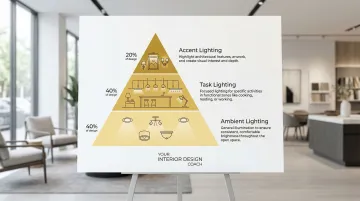
Different zones require different lighting levels, and that variation is one of the most powerful zone-definition tools available in open spaces - more effective than furniture placement alone because it works at night.
The three essential layers:
- Ambient lighting: General illumination (recessed lights, ceiling fixtures)
- Task lighting: Work-focused light where you need it, such as pendant lights over kitchen islands, reading lamps beside chairs
- Accent lighting: Mood and visual interest (picture lights, uplighting, decorative fixtures)
Install dimmers wherever possible so you can make the kitchen bright for cooking while the living area stays softly lit - different lighting levels create psychological separation even without physical barriers. This means one space can genuinely shift from work mode to wind-down without anyone moving a piece of furniture.
Coordinate Colors While Allowing Variation
What I’ve seen is that color choices are harder to ignore in an open floor plan because you see several areas at once. If the kitchen, dining area, and living room do not feel connected, the whole space can start to feel visually disconnected even when each piece looks fine on its own.
Apply the 60-30-10 rule:
- 60% dominant color (typically wall color)
- 30% secondary color (upholstery, larger furnishings)
- 10% accent color (pillows, artwork, accessories)
Strategies for cohesion with variation:
- Use the same wall color throughout, varying accent colors by zone
- Ensure all colors share similar undertones (all warm or all cool)
- Repeat key colors across zones in different proportions
- Allow each zone a signature accent color that appears as a minor note elsewhere
Create Focal Points in Each Area
Once your color palette creates visual cohesion, distinct focal points anchor each zone and guide the eye through the space.
Living area: Fireplace, large artwork, media center, or statement furniture piece
Dining area: Chandelier, pendant light, or striking table centerpiece
Kitchen: Statement backsplash, range hood, or open shelving display
Each focal point should command attention within its zone without competing with others, creating a visual journey rather than overwhelming the space.
Incorporate Semi-Transparent Dividers When Needed
Sometimes you need more separation than furniture alone provides.
Consider these partial separation options:
- Glass partitions: Maintain light flow while containing sound
- Open shelving: Creates boundary while providing storage
- Half walls: Architectural solution that preserves openness
- Sliding barn doors: Flexible separation you can open or close
- Curtains: Soft, temporary division that's budget-friendly
Choose based on your specific needs. If noise is the primary concern, opt for solid materials. If you simply need visual separation, open shelving or curtains work well.
Plan Traffic Flow and Negative Space
Clear pathways are non-negotiable in open spaces.
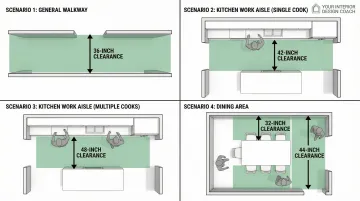
Minimum clearances:
| Area | Clearance Required |
|---|---|
| General walkways | 36 inches minimum |
| Kitchen work aisles (one cook) | 42 inches |
| Kitchen work aisles (multiple cooks) | 48 inches |
| Seating with no traffic behind | 32 inches from table edge |
| Seating with traffic passing | 44 inches clearance |
Test your layout: Before finalizing furniture placement, walk through your planned pathways. Can you move comfortably between zones? Can two people pass each other without turning sideways? Adjust as needed.
Common Mistakes to Avoid in Open Space Design
Even experienced designers fall into predictable traps when planning open layouts. Avoid these three common mistakes:
1. Over-furnishing the space
More furniture doesn't make an open plan more functional - it makes it feel cramped and blocks the 36-inch walkways that keep the space livable. Start with essentials for each zone and add pieces only when a specific need presents itself.
2. Mismatched design styles across zones
When your modern kitchen, traditional dining area, and contemporary living space all share sightlines, the result is visual chaos. Limit your material palette to three to five finishes and maintain consistent style throughout - variation is fine, contradiction isn't.
3. Neglecting acoustic treatment
Hard surfaces look sleek but amplify every sound in the space - dishwasher cycles, phone calls, TV audio - because there's nothing absorbing it. Rugs, upholstered furniture, curtains, and throws dramatically improve acoustics without compromising the aesthetic.
Getting Started: Your Open Space Design Action Plan
This checklist is designed to help you evaluate the structural limitations, daily habits, movement patterns, and practical needs of the room first, so your layout decisions are guided by real-life use instead of aesthetics alone.
- Measure your space accurately - Note architectural features, windows, doors, and electrical outlets
- Identify must-have zones - List all activities that will occur in the space
- Assess privacy needs - Determine where you need visual or acoustic separation
- Inventory existing furniture - Measure pieces you plan to keep and note their condition
- Map traffic patterns - Identify natural pathways and ensure 36-inch clearances
- Establish your budget - Determine what you can invest and where to prioritize spending
Once you've completed this checklist, the decisions can feel endless, and the fear of making costly mistakes can be paralyzing.
At YIDC, I help you work through the parts of an open layout that are hard to judge on your own: where the living area should stop, where the dining area should begin, whether the sofa is blocking the natural path, whether the rug is large enough to anchor the seating, and whether kitchen noise or visual clutter is affecting how the whole space feels.
If you’ve measured the space and still feel unsure about what to adjust, I can help you sort through the layout and decide what needs to change first. Reach out for a free consultation at 408-306-5003, and we can take it from there.
Your Quick Recap
Open floor plans solve some problems and create others. The homes that work well are the ones where someone thought carefully about both sides of that equation before removing the walls. Acoustics, visual clutter management, and zone definition are not afterthoughts in these spaces - they are the design.
- Acoustic treatment with soft furnishings is not optional in open kitchens; it is what makes the space livable
- Over-furnishing destroys open plans faster than anything else; restraint is the most important discipline
- Zone definition through rugs, lighting, and furniture placement does the work that walls used to do
- Keeping a consistent but varied color palette across zones prevents visual chaos without looking monotonous
- Natural light is your most valuable design tool in open spaces - do not block it with furniture or heavy drapes (bonus insight)
- Open layouts photograph exceptionally well for listings and sale prep when zones are cleanly defined (bonus insight)
If you're still feeling stuck and haven't been able to move things forward, let's talk! Reach out for a free consultation at 408-306-5003, and we can take it from there.
Frequently Asked Questions
How do I create privacy in an open floor plan without adding walls?
Use strategic furniture placement, position a sofa with its back to other zones, add open bookcases as partial dividers, or incorporate semi-transparent screens. Changes in ceiling height or floor levels also create psychological separation.
What's the best way to reduce noise in open concept spaces?
Add soft furnishings that absorb sound: area rugs, upholstered furniture, curtains, and acoustic panels in high-traffic zones. These materials counteract hard surfaces like tile, stone, and glass that amplify noise.
How much furniture do I need for an open living space?
Less is more in open spaces. Start with essentials for each zone, seating for living areas, dining table and chairs, necessary kitchen elements. Add pieces only as you identify specific needs.
Can I create an open floor plan on a budget?
Absolutely. Work with existing furniture in new arrangements, use affordable area rugs to define zones, and focus on paint and lighting changes rather than structural modifications. Strategic updates deliver significant impact without major investment.
How do I define different zones in an open space without using walls?
Combine multiple strategies: area rugs to anchor zones, furniture arrangement to create boundaries, zone-specific lighting, and subtle color variations. The combination creates clear definition while maintaining openness.
What are the biggest mistakes to avoid in open space design?
The top three: over-furnishing (blocks flow and creates clutter), neglecting acoustics (causes uncomfortable noise levels), and failing to establish clear zones before purchasing furniture (results in poor layout and wasted money).