Here's the thing: a great floor plan isn't about following rigid design rules or copying magazine spreads. It's about creating a space that supports how you actually live.
Your living room should work for hosting game nights, family movie marathons, or quiet reading time. When your layout fits your lifestyle, everything clicks into place, and your living room becomes a space you genuinely love spending time in.
Your Quick Summary
- There's one question you should answer before touching a single piece of furniture - most people skip it entirely
- The "right" pathway width isn't a design preference; it's tied to something most people only think about after someone trips
- The most expensive layout mistake has nothing to do with style - and 15 minutes could have prevented it
- The instinct almost everyone has about where sofas belong is quietly working against them
- Zones don't require walls or dividers - but the trick to making them feel real might surprise you
Tip 1: Start with How You Actually Live in the Space
Before you arrange a single chair or choose a sofa, ask yourself: How will this room actually be used?
A family with young kids who need play space has completely different layout needs than a couple who entertains dinner guests every weekend or someone who works from home and needs a dual-purpose space.
Questions to guide your planning:
- Do you watch TV here daily, occasionally, or not at all?
- How many people typically use this room at once?
- Do you need a workspace, play areas, or reading nooks?
- Will you host gatherings, or is this primarily a private family space?
- Do you need storage for games, books, or media equipment?
Once you've answered these questions, create two lists: "must-haves" (essential elements like TV viewing or seating for six) and "nice-to-haves" (bonus features like a reading chair or bar cart).
This prevents cramming too much in or missing key functions. In my experience, the few minutes spent answering these questions up front eliminate weeks of second-guessing furniture positions later.
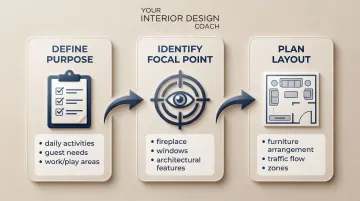
Tip 2: Identify Your Room's Natural Focal Point
Every successful living room layout starts with a focal point - the feature that naturally draws your eye when you enter the room. Identifying it first matters because every other furniture placement decision follows from it; without a focal point, arrangement becomes guesswork. Common focal points include fireplaces, large windows with views, or architectural features. If your room lacks these, your TV wall is the functional focal point.
Working with your focal point:
- Arrange your primary seating to face or complement the focal point
- Don't fight against strong architectural features; embrace them
- If you have a beautiful window, orient seating to enjoy the view
When you have competing focal points (like a fireplace on one wall and a TV on another), you have options. You can mount the TV above the fireplace if the height works, arrange furniture to face both using swivel chairs, or accept that the room serves different purposes at different times. According to interior design experts, aligning your biggest features along one axis creates visual order, for example, centering furniture on the fireplace that's aligned with an overhead light fixture.
Tip 3: Master the Art of Traffic Flow
One thing I notice often is that people unconsciously adapt to awkward layouts over time. They start squeezing past chairs, sidestepping coffee tables, or taking indirect routes through the room without realizing how much low-level friction the space is creating every single day. What feels like a “small inconvenience” is usually a traffic flow issue, and once circulation improves, the entire room often starts feeling calmer, larger, and easier to live in almost immediately.
Traffic flow essentials:
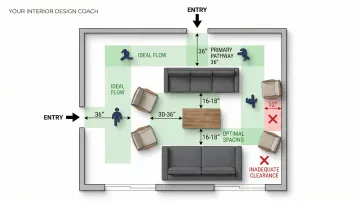
- Maintain at least 36 inches from entry points to seating areas (primary pathways)
- Allow 30-36 inches between large furniture pieces for secondary routes
- In tight spots, 24 inches is the absolute minimum, though it will feel cramped
In larger rooms, resist the urge to push everything against the walls. This actually creates awkward traffic patterns and makes conversation difficult.
Tip 4: Choose Furniture Scale That Fits Your Room
Getting furniture scale right is crucial, yet it's one of the most common and expensive mistakes people make - because wrong-scale furniture usually requires a return or replacement rather than a simple repositioning. An oversized sectional in a small room blocks pathways and feels suffocating; dainty chairs in a large space look lost and fail to anchor the room.
Room size guidelines:
- Small rooms (130-160 sq ft): Choose compact sofas (72-84 inches) and streamlined pieces
- Medium rooms (215-270 sq ft): Standard sofas (84-96 inches) work well with complementary seating
- Large rooms (320+ sq ft): Sectionals or multiple seating groups create defined zones
Coffee table proportions matter too. A reliable rule: choose a coffee table that's roughly two-thirds the length of your sofa and sits 16-18 inches away from the sofa edge for comfortable legroom while keeping drinks within reach.
Before you buy anything:
- Use painter's tape on the floor to outline furniture footprints - this one step ends the cycle of ordering, returning, and reordering pieces that looked right online but overwhelmed the room in person
- Measure doorways and hallways to ensure delivery is possible
- Consider visual weight, not just physical dimensions; a glass coffee table feels lighter than a solid wood one
Tip 5: Try Floating Furniture (Yes, Really!)
Pulling your sofa away from the wall might feel counterintuitive, especially if you've always pushed furniture to the perimeter.
But in rooms with sufficient depth (12 feet or more), floating furniture creates more intimate, functional spaces.
Benefits of floating furniture:
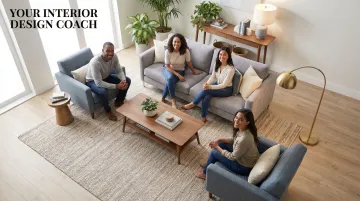
- Creates defined conversation areas where people sit 8-10 feet apart (the ideal distance for comfortable interaction)
- Improves traffic flow by establishing clear pathways
- Makes large rooms feel cozier and more intentional
- Allows you to define zones in open-plan spaces
In smaller rooms (under 10×12 feet), wall-hugging is perfectly fine and maximizes usable floor space.
If you have the square footage, try pulling your sofa 6-12 inches from the wall. Place a console table or low bookshelf behind it for functionality; it's perfect for displaying lamps, books, or plants while giving the floating arrangement purpose.
Tip 6: Work with Awkward or Challenging Spaces
Not every living room is a perfect rectangle. Long and narrow rooms, L-shaped spaces, or rooms with too many doorways present unique challenges, but they're absolutely solvable.
Long, Narrow Rooms
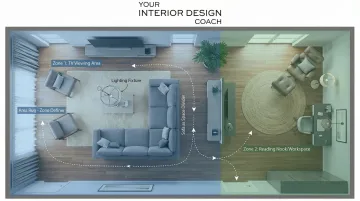
- Divide the space into two distinct zones (conversation area + reading nook, or seating + workspace)
- Place your sofa perpendicular to the long walls to visually widen the space
- Use area rugs to define each zone and prevent the "bowling alley" effect
- Create a central walkway or pathway along one side for clear circulation
L-Shaped Spaces
- Use the corner for an L-shaped sectional to anchor one zone
- Let the "leg" of the L serve a different function (dining, workspace, or play area)
Rooms with Multiple Doorways
- Arrange furniture to create conversation areas that don't block doorways
- Accept that some pathways will cut through the space and plan accordingly
- Use smaller-scale furniture that doesn't obstruct views through the room
Use area rugs as your secret weapon for making awkward shapes feel intentional. This guide to area rug rules offers detailed placement strategies. Choose a rug large enough that at least the front legs of all seating rest on it, and leave 12-18 inches of exposed floor around the perimeter to frame the space.
Tip 7: Create Distinct Zones in Open or Multi-Purpose Spaces
Open-plan living rooms or spaces that serve multiple functions (TV watching + kids' play area, or relaxation + home office) need clear zoning to feel organized rather than chaotic.
Zoning techniques that work:
- Furniture arrangement: Use the back of a sofa as a divider between zones
- Area rugs: Different rugs define different areas without physical barriers
- Lighting: Separate lamps or fixtures for each zone create visual distinction
- Shelving units: Open bookcases divide space while maintaining sightlines
Successful zone combinations:
- Seating area + reading nook (chair in corner with floor lamp)
- TV viewing area + play space (sectional facing TV, play mat and storage in opposite corner)
- Conversation area + workspace (sofa grouping + desk along wall or behind sofa)
Each zone should feel complete with its own purpose while maintaining visual cohesion across the room. For example, if your seating area features navy accent pillows, repeat that navy in your workspace through a desk accessory or wall art. This creates distinction without disconnection.
Tip 8: Layer Your Lighting for Flexibility
Once you've established your zones, lighting brings them to life. Even a perfectly arranged room falls flat with bad lighting. Overhead fixtures alone create harsh shadows and a one-dimensional atmosphere. Proper lighting design requires three distinct layers: ambient, task, and accent.
The three essential lighting layers:
- Ambient lighting provides general illumination for moving through the room and basic visibility (recessed lights, ceiling fixtures, or cove lighting)
- Task lighting serves specific activities like reading, games, or laptop work (table lamps on end tables, floor lamps beside chairs, desk lamps)
- Accent lighting adds visual interest and highlights features (picture lights, uplights on plants, decorative fixtures)
Practical placement tips:
- Flank your sofa with matching table lamps on end tables for balanced task lighting
- Place a floor lamp in your reading corner at shoulder height when seated
- Install dimmer switches on overhead fixtures for flexibility
- Consider outlet locations when planning furniture placement; you'll need power for lamps
Connect each layer to separate switches or dimmers so you can adjust lighting for different activities and times of day. The goal is flexibility. Movie night needs different lighting than morning coffee or evening entertaining.
Tip 9: Measure Everything (Twice)
This tip isn't glamorous, but it prevents expensive mistakes. Incorrect furniture scale is one of the costliest layout errors, and you can completely avoid it with 15 minutes of measuring.
Your measurement checklist:
- Room dimensions (length, width, and any alcoves or bump-outs)
- Doorway widths and swing direction
- Window heights, widths, and distance from floor
- Ceiling height and any soffits or beams
- Existing furniture you plan to keep
- Radiators, vents, or outlets that affect placement
Tools to help you plan:
- Graph paper and pencil for scaled drawings
- Free online room planners (many furniture retailers offer these)
- Painter's tape to outline furniture footprints on your floor
- Your smartphone's measuring app for quick dimensions
If measuring and visualizing feels overwhelming, you're not alone; many people struggle with translating measurements into spatial reality.
If your layout still feels awkward after moving things around a few times, I can help you figure out whether the issue is spacing, furniture scale, or traffic flow.
Sometimes a few layout adjustments completely change how the room feels day to day. If you are stuck and want help figuring out what is not working, reach out at 408-306-5003 and we can talk it through together.
Tip 10: Test Your Layout Before Fully Committing
Even the best-planned layout on paper might feel different in real life. Before you invest in new furniture or commit to a permanent arrangement, test your ideas.
Testing methods that work:
- Use cardboard cutouts sized to match furniture pieces you're considering
- Move existing furniture into the proposed arrangement and live with it for a week
- Sit in every seat at different times of day to check comfort, lighting, and views
- Walk through the space repeatedly to confirm traffic flow feels natural
Trust your instincts. If something feels off (the TV seems too far away, the coffee table is awkwardly placed, or the seating feels scattered), it probably is. That's valuable information, not failure. Adjust and test again.
In my experience, what feels “off” in a living room is often not the furniture itself. It’s usually the spacing, the walkway, or trying to make one room work for too many things at once.
Your Quick Recap
A living room layout that works is invisible - you just feel comfortable in the space. One that does not work makes itself known every day through bumped shins, awkward conversation distances, and a vague sense that something is off. The difference is almost always in the clearances and the focal point, not the furniture itself.
- Floating furniture away from walls creates intimacy; hugging walls creates a waiting room
- Identifying your focal point first makes every other placement decision easier and faster
- Traffic flow is not a design preference - it is a daily experience; protect those 36-inch pathways
- Testing with painter's tape before moving anything saves time, money, and your back
- Rugs that are too small for the furniture grouping are the most common layout mistake in living rooms (bonus insight)
- If two people cannot have a comfortable conversation seated in your space, the furniture is too far apart (bonus insight)
If you're still feeling stuck and haven't been able to move things forward, let's talk! Reach out for a free consultation at 408-306-5003, and we can take it from there.
Frequently Asked Questions
How far should my sofa be from the TV?
For 4K TVs, sit approximately 1.5 times the TV's vertical screen height away; for older HD models, use 3 times the vertical height. This prevents eye strain while allowing you to appreciate picture quality.
Should I float my furniture or push it against the walls?
In rooms larger than 10×12 feet, floating furniture usually creates better conversation areas and flow. In very small spaces, wall-hugging maximizes usable floor space. Consider whether you prioritize conversation groupings or maximum open floor space.
What's the minimum walkway width I should leave in my living room?
Maintain 36 inches for primary pathways and 30-36 inches between large furniture pieces. In tight spots, 24 inches is the bare minimum, though it will feel cramped.
How do I arrange furniture in a long, narrow living room?
Divide the room into two zones using furniture or rugs, place your sofa perpendicular to the long walls to visually widen the space, and create a clear pathway along one side or down the center.
What should I do if my living room has multiple focal points (like a fireplace AND a TV)?
Arrange furniture to face both using swivel chairs, mount the TV above the fireplace if viewing angles allow, or use flexible seating that adapts as the room's purpose shifts throughout the day.
Do I really need to measure before buying furniture?
Yes, incorrect scale is one of the costliest layout mistakes. Measuring takes 15 minutes; returning furniture that doesn't fit through doorways costs time, money, and frustration.