Kitchen renovations deliver some of the highest returns in real estate: minor kitchen remodels recoup approximately 81% of their cost in property value. That's why kitchen design for rentals isn't about following trends or installing luxury finishes - it's about creating spaces that appeal to tenants, hold up to years of heavy use, and justify higher rents.
Whether you're targeting long-term renters who need functional workspace or short-term Airbnb guests seeking Instagram-worthy aesthetics, the right design decisions directly impact your bottom line
This guide shows how to design rental kitchens that balance durability with appeal, make the most of your budget for strong ROI, and create spaces that keep tenants renewing leases, whether you're managing traditional rentals or vacation properties.
Your Quick Summary
- Durable materials like quartz countertops reduce maintenance calls and tenant damage
- Neutral palettes (soft whites, warm grays) appeal broadly and accelerate leasing
- Cabinets, countertops, and storage deliver the highest ROI for your renovation budget
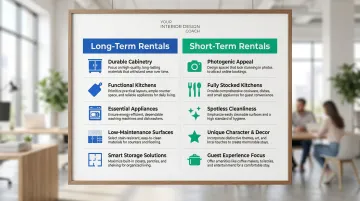
- Long-term renters prioritize functionality and storage; short-term guests expect fully-equipped, photogenic spaces
- $10,000 kitchen updates can boost monthly rent by $100-200, delivering strong ROI
Understanding Your Rental Market: Long-Term vs. Short-Term Strategy
Your kitchen design strategy should match your rental model. Long-term and short-term rentals require different approaches to materials, aesthetics, and amenities.
Long-Term Rental Priorities
Traditional renters view the kitchen as daily workspace. They prioritize:
- Functional storage for groceries, cookware, and pantry items
- Adequate counter space for meal preparation
- Reliable appliances including dishwashers (87% of renters consider this essential) - a working dishwasher is one of the small daily conveniences that tenants notice immediately and factor heavily into renewal decisions
- Durable surfaces that tolerate daily cooking without showing wear
- Practical layouts that support efficient workflow
These tenants care less about design trends and more about whether the kitchen makes their daily routine easier.
That is usually where I recommend starting too. Before choosing a backsplash or cabinet color, look at whether the kitchen has enough counter space, easy storage, and appliances that make everyday cooking and cleanup feel simple.
Short-Term Rental Expectations
Airbnb and Vrbo guests compare your property to hotels and other listings. They expect:
- Photogenic aesthetics that match listing photos and create shareable moments
- Fully-equipped amenities including quality cookware, utensils, and small appliances
- Modern finishes that signal cleanliness and recent updates
- Hotel-like presentation with cohesive design and attention to detail
For short-term rentals, kitchen photos appear in nearly every listing and are among the first images guests evaluate. Neutral, professionally styled kitchens photograph better and appeal to diverse guests - which means a dated kitchen actively suppresses booking rates regardless of the property's other strengths. If you're stuck on which direction to take, call 408-306-5003 for a free consultation - we can help you prioritize the changes that will actually move the needle for your specific property.
Demographic Considerations
Within each rental model, your target demographic further refines your approach:
- Families: Need larger refrigerators, ample counter space, and durable flooring that handles spills
- Young professionals: Value modern appliances, open layouts, and stylish finishes
- Students: Require low-maintenance surfaces and basic functionality over luxury features
Kitchen upgrades can justify $50-100 higher monthly rent for long-term properties.
In competitive markets, updated kitchens reduce vacancy periods and improve tenant retention, delivering returns of 70-100% through combined rent increases and reduced turnover costs.
Layout & Storage Solutions for Rental Kitchens
Efficient layouts increase functionality within typical rental space constraints. National Kitchen & Bath Association (NKBA) guidelines help create comfortable, code-compliant kitchens that work for various cooking styles.
Essential Kitchen Dimensions
Plan your kitchen around these critical measurements:
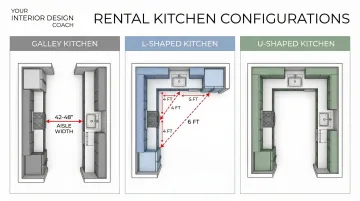
- Work aisles: Minimum 42 inches for one cook; 48 inches for multiple cooks
- Walkways: Minimum 36 inches for through-traffic
- Work triangle: Total distance between sink, refrigerator, and cooktop should not exceed 26 feet, with each leg between 4-9 feet
Landing space needed:
- Sink: 24 inches on one side, 18 inches on the other for dish staging
- Cooktop: 12 inches on one side, 15 inches on the other for hot pan placement
- Refrigerator: 15 inches on the handle side for loading/unloading
Once you know these measurements, you can choose the layout that best fits your space and cooking needs.
Efficient layout options:
Galley kitchens work well in smaller rentals. Two parallel counters create efficient workflow and maximize storage in limited square footage. Keep aisle width at 42-48 inches minimum.
L-shaped layouts suit medium-sized spaces:
- Creates natural work triangle
- Opens one side for dining area or island
- Provides corner storage opportunities
With a U-shaped layout, you get three walls of cabinets and counter space, ideal for serious cooks. This configuration requires adequate room to avoid a cramped feel.
Storage That Adds Value
Inadequate storage ranks among the top renter complaints. Strategic upgrades transform kitchen functionality without major renovation costs.
High-impact storage solutions:
- Pull-out shelves in base cabinets improve accessibility
- Lazy susans maximize corner cabinet space - turning a dead-zone corner into usable storage means tenants stop losing things to the back of the cabinet and keep the kitchen organized longer
- Drawer dividers create organized utensil storage
- Pantry organization systems help maintain order
I would look at storage before adding decorative upgrades. If tenants do not have a clear place for pantry items, pans, cleaning supplies, or everyday utensils, the kitchen starts feeling harder to use no matter how nice the finishes are.
Color & Design Choices for Universal Appeal
Neutral palettes aren't boring; they're strategic. The right colors appeal to diverse tenants and photograph exceptionally well for listings.
The Data on Neutral Colors
Properties with neutral backsplashes rent 41% faster than those with personalized designs - because neutral surfaces let prospective tenants project their own belongings into the space instead of mentally subtracting yours.
Top-performing paint colors:
- Soft whites: "White Dove" (Benjamin Moore) and "Alabaster" (Sherwin-Williams) create bright, spacious feels
- Warm grays: "Agreeable Gray" (Sherwin-Williams) and "Revere Pewter" (Benjamin Moore) offer versatility and warmth
- Warm beiges: Greige tones bridge gray and beige, appealing to both modern and traditional preferences
These colors work because they tap into fundamental design psychology.
Color Psychology for Rentals
Neutral tones create measurable advantages:
- Whites and light grays make small kitchens feel larger and brighter
- Warm neutrals create welcoming, comfortable atmospheres
- Cohesive palettes make properties feel professionally designed
For short-term rentals, neutral and cool tones photograph better and drive higher booking interest.
Adding Personality Without Risk
Create visual interest through easily changeable elements:
- Cabinet hardware in brushed nickel, matte black, or brass adds style without permanent commitment
- Lighting fixtures like pendant lights over islands create focal points
- Backsplash provides opportunity for subtle pattern or texture while maintaining neutral palette
Avoid bold permanent choices like brightly colored cabinets or trendy tile patterns - they narrow your tenant pool and typically require an expensive repaint within five years.
If you're struggling to balance neutral appeal with distinctive character, design coaching can help you find that sweet spot, making choices that attract tenants while reflecting quality and care.
Budget-Smart Upgrades That Maximize ROI
Strategic spending focuses on changes tenants notice immediately while avoiding over-improvement that doesn't justify higher rents.
High-Impact, Low-Cost Improvements
These upgrades under $500 significantly improve perceived value:
Modern cabinet hardware ($100-200):
- Instantly updates dated cabinets with brushed nickel or matte black finishes
- Can justify $50-75 higher monthly rent
Under-cabinet LED lighting ($150-300):
- Improves functionality and ambiance while making kitchens feel more upscale
- Energy-efficient operation appeals to eco-conscious tenants
New faucet ($100-250):
- Highly visible upgrade that signals recent updates
- Pull-down spray models add functionality; brushed finishes hide water spots better than chrome
Peel-and-stick backsplash ($100-200):
- Protects walls and modernizes appearance
- Easy DIY installation and simple to replace between tenants if damaged
These minor updates combined can justify $100-150 higher monthly rent, recovering costs within 3-5 months.
When to Splurge vs. Save
Not all kitchen elements deserve equal investment. I usually recommend putting money into the pieces that get used every day.
Worth higher investment:
- Cabinets: Most visible element; quality cabinets last 15-20+ years
- Countertops: Daily use surface; quartz prevents replacement cycles
- Appliances: Mid-range, reliable models (GE ranks highest for reliability) reduce maintenance calls
Where to save:
- Decorative elements: Avoid expensive tile patterns or custom features
- Trendy finishes: Skip copper sinks, unusual colors, or statement pieces
- Luxury appliances: Professional-grade ranges aren't necessary; tenants won't pay premium rents for them
The $10,000 Kitchen Remodel
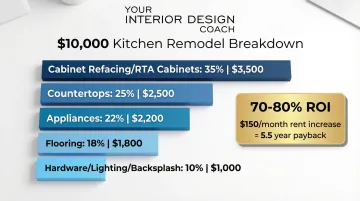
A $10,000 budget delivers a major facelift for rental kitchens when you allocate funds strategically. I would not recommend spreading that budget across too many small upgrades that barely change how the kitchen functions day to day. A smaller number of well-planned improvements usually has a much bigger impact on how updated and usable the space feels.
Realistic $10,000 allocation:
- Cabinet refacing or RTA (ready-to-assemble) cabinets: $3,000-4,000
- Laminate or budget quartz countertops: $2,000-3,000
- Mid-range appliances (if needed): $2,000-2,500
- LVP flooring: $1,500-2,000
- Backsplash, hardware, lighting: $500-1,000
This level of renovation typically yields 70-80% ROI through increased rents and improved tenant retention.
If kitchen updates justify $150 higher monthly rent, you'll recover a $10,000 investment in approximately 5.5 years, well within the lifespan of quality materials.
As a general guideline, keep kitchen remodels between 5-15% of total property value to avoid over-improving for your market.
Future-Proofing Your Rental Kitchen
Smart budget allocation means nothing if your design choices look dated in three years. Focus on elements that remain attractive for 10+ years to protect your investment.
Timeless elements:
- Shaker-style cabinets: Classic profile that never goes out of style
- Subway tile backsplash: Simple, clean, and perpetually popular
- Neutral color palettes: Whites, grays, and beiges appeal across decades
- Quality materials: Quartz and LVP maintain appearance longer than budget alternatives
Trends to approach cautiously:
- Smart appliances: Experience nearly 40% more problems than standard models; higher failure rates mean more maintenance calls
- Bold colors: Navy cabinets or colorful tile may look dated within 5 years
- Industrial styles: Exposed elements and raw finishes are trending now but may not have staying power
Growing trends worth considering:
- Open layouts: Kitchens connecting to living spaces remain popular
- Natural light: Maximize windows where possible
- Easy-clean surfaces: Non-porous materials align with wellness and hygiene priorities
Rental kitchens are easy to overspend on because there is always one more thing you could update. A lot of owners end up replacing features that are still working well while overlooking the changes that would make a bigger difference to daily usability and tenant appeal. I help clients figure out what actually needs attention, what can stay as-is, and which updates will have the strongest long-term impact without pushing the renovation budget further than it needs to go.
If you’re feeling stuck on where to start, call 408-306-5003 for a free consultation, and we can talk through it.
Your Quick Recap
Rental kitchen design is fundamentally an ROI decision, not an aesthetic one. Every upgrade you choose should answer one question: does this help me charge more, rent faster, or keep tenants longer? When the answer is yes to two of those three, it is almost always worth doing.
- Neutral palettes are not boring - they are strategic; they appeal to the widest possible tenant pool
- Quartz over laminate is a long-term cost decision, not just a style preference
- Storage upgrades have the highest tenant satisfaction impact per dollar spent
- Hardware changes are the fastest way to modernize a dated kitchen without touching cabinets
- The $10,000 kitchen remodel framework recovers its investment in under six years through higher rent alone (bonus insight)
- For short-term rentals, kitchen photography matters as much as living room photography to booking conversion (bonus insight)
If you're still feeling stuck and haven't been able to move things forward, let's talk! Reach out for a free consultation at 408-306-5003, and we can take it from there.
Frequently Asked Questions
How to style a rental kitchen?
Keep styling clean and neutral. Long-term rentals need minimal staging; tenants add personal touches. Short-term rentals require complete essentials: matching dish towels, soap dispensers, and full cookware sets with a hotel-like appearance that photographs well.
Is $10,000 enough for a kitchen remodel?
Yes, for cosmetic rental updates. A $10,000 budget covers cabinet refacing, budget quartz countertops, mid-range appliances, and LVP flooring, delivering 70-80% ROI through higher rents. For structural work or high-end finishes, budget $15,000-25,000.
What kitchen features do tenants care about most?
Long-term tenants prioritize storage, dishwashers (87% consider essential), counter space, good lighting, and clean appearance. Functional layouts matter more than trendy designs. Short-term guests need fully-equipped cookware and photogenic finishes matching listing photos.
Should I install high-end appliances in a rental property?
No. Choose mid-range, energy-efficient appliances from reliable brands. Tenants won't pay significantly more for luxury features, but you'll face premium prices and higher repair costs. Avoid smart appliances; they experience 37% more problems than standard models.
How often should rental kitchen cabinets be replaced?
Quality cabinets last 15-20+ years with proper maintenance. Plan for refinishing or hardware updates every 7-10 years. Replace only when boxes are water-damaged or structurally compromised; cabinet refacing saves 30-50% when boxes remain sound.
What's the best backsplash for a rental kitchen?
Classic white subway tile offers timeless appeal, easy cleaning, and simple repair. For budget updates, quality peel-and-stick backsplash provides easy installation and replacement. Properties with neutral backsplashes rent 41% faster than personalized designs.