Over my nearly 20 years working with homeowners, I have seen it happen at beach houses, mountain cabins, lakeside retreats, and desert homes alike. The kitchen is where the vacation actually lives. It is where the morning starts, where meals turn into memories, and where families figure out what they mean to each other when the pace of regular life slows down.
That is why the kitchen in a vacation home deserves thoughtful design - not as an afterthought, but as the intentional heart of the space. This guide will walk you through everything I consider when helping clients design or update a vacation kitchen, from layout and materials to lighting, storage, and regional style.
Your Quick Summary
- A vacation home kitchen serves family gatherings and relaxed entertaining, and should be designed around how people actually experience time away together
- Layouts work best when they allow multiple people to move freely and cook simultaneously without colliding
- Materials should be durable enough that you stop worrying about damage and start actually relaxing
- Storage that is logical and easy to navigate removes daily friction and makes the space feel like home immediately
- The kitchen island is your most valuable gathering tool - invest in it thoughtfully
- Lighting sets the emotional tone of the space and should support both active cooking and quiet evenings
- Regional style creates a sense of place that makes a vacation home feel distinct and special
- Spend on the things you touch and use every day; save on elements that are visual without being functional
Why the Vacation Home Kitchen Is Different
The most common mistake I see clients make when designing a vacation kitchen is treating it exactly like their primary kitchen. They optimize for how they cook at home during a regular Tuesday, which means tight layouts, minimal prep space, and storage organized around their personal routines.
Vacation kitchens need to work differently. You are often cooking for more people - extended family, friends, large groups. You are cooking in an unfamiliar space alongside people who have their own habits. You are doing it while relaxed and unhurried, which means the kitchen needs to feel open and inviting rather than efficient and contained.
In my experience, the biggest frustration people report about their vacation kitchens is a sense of chaos during meal prep. Too many people in a tight space, no clear workflow, not enough counter room, drawers that do not make sense to anyone except the person who organized them. These are solvable problems, and solving them transforms a functional kitchen into a genuinely enjoyable one.
There is also an emotional dimension to this. When a vacation kitchen is hard to use, it creates low-grade stress at the exact moments when people want to feel free. When it works beautifully, it disappears into the background - the cooking just flows, the gathering happens naturally, and the kitchen does its job without demanding attention.
Layout and Flow for Entertaining and Groups
Designing for Multiple Cooks
Here is where I would start with any vacation kitchen redesign: imagine three or four people cooking and moving around at the same time. Where do they collide? Where does the flow break down? That is your design problem to solve.
The classic kitchen work triangle - sink, stove, refrigerator positioned in a tight triangle - was designed for one efficient cook. It works well for everyday kitchens. In vacation homes, I recommend expanding that thinking into distinct work zones instead.
A beverage and coffee station pulled away from the main prep area means someone can make drinks without stepping into the cooking zone. A secondary prep area near the refrigerator lets one person chop vegetables while someone else manages the stove. These zones do not require a huge kitchen - they require intentional placement.
Walkway clearance matters more in vacation kitchens than in primary ones. People need to be able to move behind someone who is working without disrupting what they are doing - and that margin becomes critical when three or four people are navigating the same space at once. Getting this right keeps the energy light rather than tense.
Open Flow into Living Spaces
Most of the vacation homes I work with benefit from visual and physical connection between the kitchen and the main living or dining area. This is not just an aesthetic preference - it changes how people experience being together.
When the kitchen opens toward the living room or toward an outdoor deck, the person cooking is not isolated. They can stay part of the conversation. Kids can be watched from the stove. The meal prep becomes part of the gathering rather than a separate task happening offstage.
If your vacation home has a more closed kitchen layout, even small changes can improve this. A window cut into a wall, a pass-through counter, or simply removing upper cabinets on one wall to create visual openness can make a meaningful difference in how connected the space feels. This principle of open-plan kitchen and dining room design applies as much to vacation homes as to primary residences.
Materials and Finishes That Hold Up Without Demanding Attention
The Durability Mindset
One thing I tell every client who is renovating a vacation kitchen: choose materials that allow you to relax. That sounds simple, but it has real design implications.
If you choose a light-colored marble countertop that stains easily, you will think about that countertop every time someone pours a glass of red wine. If you choose flooring that shows every grain of sand tracked in from the beach, you will feel a low level of stress every day of your vacation.
The right materials do the opposite. They hold up, they clean easily, and they fade into the background so you can focus on the people in the room.
Countertops
For vacation home countertops, I almost always recommend quartz engineered stone as the primary surface. It is non-porous, which means it does not require sealing and does not stain the way natural stone can. It is consistent in its patterning, it handles the range of cooking tasks people do on vacation - heavy baking sessions, large meal preps, kids making snacks - and it stays looking good without any special maintenance.
Granite is a beautiful option if you love the natural variation and you are committed to sealing it annually. For a vacation home where you may not be there every week, that maintenance commitment can slip, which means the countertop eventually shows staining.
Butcher block adds warmth and works beautifully as an accent surface, particularly near an island. I would not use it as your primary countertop in a vacation home unless you are very attentive to oiling and drying. It absorbs moisture and can warp or mold if left wet - not ideal for a home you are not at every day.
Flooring
Vacation kitchen floors take real punishment. Sand, wet feet from a pool or lake, muddy shoes from a hike, heavy foot traffic during large gatherings. This is not the place to use delicate materials.
Luxury vinyl plank is my top recommendation for most vacation kitchen floors. Specify a 20-mil wear layer for durability that approaches commercial grade. It is completely waterproof, handles sand and grit without scratching the way hardwood can, and it comes in wood-look finishes that are genuinely warm and attractive. The upfront cost is reasonable, the lifespan is 15 to 25 years with good installation, and it requires almost no maintenance beyond regular cleaning.
Porcelain tile is another excellent option, especially for coastal homes or any space with significant water exposure. PEI 4 or 5 ratings handle heavy traffic reliably. The grout lines require periodic sealing, which is the main maintenance consideration, but the tile itself is nearly indestructible.
I generally steer clients away from solid hardwood in vacation kitchens. It can work in mountain homes with lower humidity and guests who remove shoes, but anywhere near water it becomes a long-term maintenance burden.
Cabinet Finishes
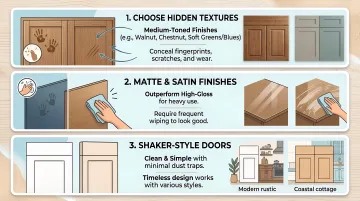
Choose cabinet finishes that hide the reality of how a vacation kitchen gets used. Medium-toned finishes in warm walnut, chestnut, or soft greens and blues conceal fingerprints, minor scratches, and daily wear far better than stark white or very dark solid colors.
Matte and satin finishes outperform high-gloss in a kitchen that sees heavy use. High-gloss shows every smudge and requires frequent wiping. A quality matte or satin finish looks good between cleanings without any special effort.
Shaker-style cabinet doors are my standard recommendation for vacation kitchens. They are clean and simple, they work with a range of regional styles, and they have minimal ornamentation that traps dust. They are also timeless enough to not feel dated in five years.
Storage That Removes Stress and Keeps Things Organized
Why Storage Matters More in a Vacation Kitchen
Storage in a vacation kitchen is not just about having enough space. It is about how quickly and easily people can find what they need in a kitchen that is not their own.
What I have noticed with clients is that disorganized or illogical storage creates a specific kind of friction on vacation - the kind where you spend ten minutes looking for the can opener, or where every drawer feels like a jumble of unrelated items. That friction is small, but it accumulates. It makes the kitchen feel less welcoming, and it subtly undermines the ease that a vacation is supposed to provide.
Good storage design solves this. When the kitchen is organized in a way that makes sense intuitively - dishes near the dishwasher, pots near the stove, glasses visible and accessible - people navigate it confidently from the first day. The kitchen becomes easy rather than puzzling.
Storage Solutions Worth Prioritizing
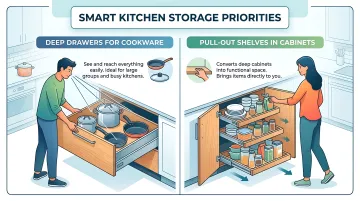
Deep drawers for pots, pans, and cookware are significantly more functional than lower cabinets with shelves. You can see everything, reach everything, and pull out what you need without moving six other items first. For a vacation kitchen serving large groups, this makes a real difference during meal prep.
Pull-out shelves in lower cabinets transform deep storage from frustrating to functional. The back of a cabinet that requires you to crouch and dig is essentially dead storage. Pull-out shelves bring everything to you.
An oversized pantry or dedicated pantry cabinet changes how a vacation kitchen feels to use. Having a central, organized place for staples, snacks, and small appliances keeps counters clear and gives the kitchen a sense of calm even when a lot of cooking is happening.
Clear containers for pantry staples - pasta, rice, coffee, snacks - serve a practical purpose beyond aesthetics. In a home where different people use the kitchen throughout a season, clearly visible and labeled containers mean no one has to guess what is in a jar or whether something has expired.
Open shelving for dishware on one or two sections of wall creates easy access and a welcoming visual. Seeing neatly stacked plates and glasses makes a kitchen feel ready and hospitable. I usually recommend limiting open shelving to one or two sections rather than the entire kitchen - a full wall of open shelving creates more visual clutter than it resolves.
The Kitchen Island - The Heart of the Gathering Space
More Than a Prep Surface
If there is one element in a vacation kitchen that earns its investment more than any other, it is the island. I have seen islands transform how families use their kitchens - from a space where one person cooks alone to a place where everyone gathers.
An island that is sized for seating of four or more people becomes the natural center of the room. Kids do homework at it while a parent cooks. Adults linger with a drink while someone else finishes the meal. It is the surface where people set down what they are carrying when they come inside, where casual conversations happen, where everyone gravitates without being told to.
A larger island is not just more prep space. It is the physical anchor of the gathering. In my experience, clients who invest in a well-designed island almost always say it was the single best decision they made in the kitchen.
Island Design Considerations
Size the island to provide at least 36 inches of clearance on all sides for traffic flow. 42 inches is better if your kitchen allows it. An island that is too tightly fitted into a space creates congestion rather than solving it - you want people to be able to move around it freely, including when others are seated at it.
Seating for at least four people is my standard recommendation. For larger vacation homes that regularly host extended family or friend groups, seating for six or even eight is worth designing toward.
Include electrical outlets in the island surface or base for phone charging, laptops, and small appliances. This is a small design detail that gets used every single day of a vacation.
A two-tier island design - one level for prep, a raised level for seating and casual dining - keeps prep mess visually separated from the dining surface. This is particularly useful in vacation homes where cooking and socializing overlap constantly.
Consider the countertop surface on the island separately from your main countertops. A wood accent surface or a contrasting stone adds warmth and visual interest. The island is a focal point, so its materials can afford to be slightly bolder than the surrounding counters.
Appliances and Equipment Worth Investing In
Prioritize What Gets Used Most
One mistake I see often in vacation kitchens is either under-equipping or over-equipping. Some clients scrimp on appliances thinking the kitchen does not need to be fully functional since they are only there occasionally. Others install professional-grade equipment that never gets used because the cooking style on vacation is casual rather than elaborate.
Here is how I think about it: invest in the appliances that your family actually uses, and make sure those work exceptionally well. Underperform on the things you will rarely touch.
For most vacation households, a reliable dishwasher is the single most impactful appliance investment. Large groups create a lot of dishes, and having a dishwasher that actually cleans well and runs quietly makes post-meal cleanup painless. I recommend a quieter model in the 45-decibel range or below - you will notice the difference when it is running during an evening gathering.
A refrigerator sized generously for your typical group is essential. Vacation cooking often means more fresh food, more beverages, and larger quantities of everything. A standard apartment-sized refrigerator creates constant frustration when eight people are sharing it for a week.
A coffee station with a quality coffee maker is one of those small investments that pays off in daily satisfaction. Morning coffee is often a ritual on vacation - people linger over it, it sets the tone for the day. A good coffee setup signals that the kitchen was thought about with care.
A large, deep sink - ideally a farmhouse or apron-front style - handles the demands of vacation cooking better than a standard double-bowl sink. Large pots, sheet pans, and the general scale of cooking for groups requires more sink real estate than everyday cooking.
What You Can Skip
You do not need the most sophisticated range or cooktop for a vacation kitchen unless cooking is genuinely the focus of your time there. A reliable mid-range range with good burners and an oven that holds temperature accurately is sufficient for most vacation cooking.
Specialty appliances - built-in espresso machines, wine refrigerators, steam ovens - are worth it only if they match how your family actually uses the space. Do not install them to impress visitors if they will sit unused. Spend that budget on the things that affect daily experience instead.
Lighting That Sets the Mood
The Layered Lighting Approach
Lighting in a vacation kitchen does two jobs, and a good design addresses both. The first job is functional: you need enough light to see what you are doing while cooking, chopping, and reading labels. The second job is atmospheric: you want the ability to soften the space for evenings, for relaxed meals, for that particular quality of light that makes a vacation home feel like a refuge.
A single overhead fixture does neither job well. The layered approach gives you control.
Task lighting - usually under-cabinet fixtures - illuminates the countertop surfaces where you actually work. LED strips work reliably and use minimal energy. This is non-negotiable in a kitchen where multiple people are cooking, because shadows created by overhead-only lighting make prep surfaces harder to use safely.
Ambient lighting from ceiling fixtures or recessed cans provides the baseline illumination for the overall space. I recommend fixtures on a dimmer so you can lower the light level during meals and evenings.
Accent or statement lighting - a pendant or two over the island, a chandelier over the dining area - defines the character of the kitchen and creates the atmosphere that makes the space feel special. This is where you have the most latitude to express the personality of your vacation home.
Fixture Style and Regional Fit
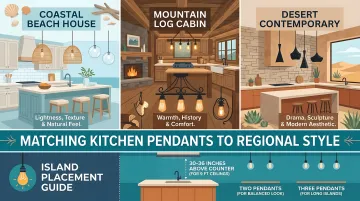
The fixtures you choose communicate a lot about the feeling of the space. In a coastal home, woven rattan pendants or simple glass globes add lightness and texture. In a mountain cabin, iron fixtures with Edison-style bulbs bring warmth and a sense of history. In a desert contemporary home, sculptural modern pendants create drama against natural stone and warm plaster walls.
I encourage clients not to default to the same fixtures they would choose for their primary home. A vacation kitchen is an opportunity to commit more fully to a sense of place. Fixtures that feel slightly bold or characterful in a showroom often feel exactly right once they are installed in a space designed around them.
Pendants over an island should hang 30 to 36 inches above the counter surface for standard 9-foot ceilings - lower for higher ceilings. Two or three pendants in a row over a long island generally look more balanced than a single large fixture.
Regional Style - Designing for Your Location
Why Regional Style Matters
One of the things I love most about vacation home design is the permission it gives to commit to a sense of place. Your primary home often needs to be versatile, to reflect who you are in a general way. A vacation home can be more specific. It can feel like the mountains, or the coast, or the desert in a way that makes arriving there feel like a genuine departure from everyday life.
The kitchen is where that sense of place lives most powerfully, because it is where you spend so much time. Getting the regional style right means the kitchen reinforces the experience of where you are, rather than feeling like it could be anywhere.
Coastal Homes
Coastal kitchens work best when they embrace lightness, air, and the visual language of the water and shore. Light color palettes - soft whites, seafoam greens, sandy beiges, washed blues - keep the space bright and connected to the environment outside.
Natural textures bring warmth without heaviness: woven pendants, open shelving in light-toned wood, rope or ceramic hardware. Shiplap or beadboard on one wall or an island adds texture without competing with the view.
Waterproof flooring is essential in a coastal kitchen. Sand comes in from the beach, wet feet come in from the pool, and moisture levels are generally higher near the water. Luxury vinyl plank or large-format porcelain tile handles this reliably.
Coastal kitchens also benefit from an indoor-outdoor connection. If there is an opportunity to add a pass-through window to an outdoor dining area or a large sliding door that opens the kitchen to a deck, that connection makes the space feel significantly larger and more in tune with why people come to a beach house in the first place.
Mountain and Lake Homes
Mountain and lakeside kitchens invite warmth, texture, and the feeling of being cocooned in a beautiful landscape. The materials and colors shift toward earth tones and natural elements: warm wood cabinetry in oak, walnut, or knotty pine; stone accents in slate or river rock; deep greens, warm browns, and stone grays in paint and textiles.
Exposed wood beams and open shelving in rough-hewn or reclaimed wood add a sense of history and authenticity that feels right in a mountain setting. Wrought iron hardware and lighting fixtures with Edison-style bulbs reinforce the aesthetic without being heavy-handed.
These kitchens should feel communal. Large islands with generous seating, open layouts that connect to a great room or stone fireplace, lighting that is warm rather than cool - all of these choices support the sense of gathering around a fire that mountain homes are built around.
Think about the scale of use these kitchens absorb during peak seasons. Holidays and long weekends often mean a full house for days at a stretch - more meals, more dishes, more foot traffic than most primary kitchens ever see in a month. Designing with that intensity in mind means the kitchen remains genuinely functional rather than just surviving the season.
Desert and Southwestern Homes
Desert kitchens have their own distinctive vocabulary that I find deeply compelling to work with. The landscape itself provides the palette: terracotta, warm clay, sage green, sandy tan, the warm gray of stone. Materials and finishes should echo the environment rather than contrasting with it.
Natural stone countertops with warm undertones - granite or quartz in sand, cream, or warm gray tones - feel right in these spaces. Textured tile backsplashes in Saltillo or handmade ceramic tile add authenticity. Hammered copper or cast iron sinks bring warmth and craft. Wrought iron hardware and lighting complete the picture.
The indoor-outdoor connection is arguably more important in desert kitchens than anywhere else. Large windows, pass-throughs to outdoor dining areas, or full pocket doors that open to a covered patio allow the kitchen to expand during the cooler desert mornings and evenings when outdoor living is most enjoyable.
Light management matters too. Desert light is intense, and a kitchen that faces south or west needs thoughtful shading - either through window placement, deep overhangs, or interior shading solutions - to remain comfortable and functional during bright afternoons.
If you are working through regional style decisions and feeling uncertain about how to pull it all together, this is exactly the kind of design problem I help clients solve through ongoing design support. Sometimes it takes someone asking the right questions to bring clarity to what a space wants to be.
Budget Priorities - Where to Spend and Where to Save
The Return on Investment Is in Daily Experience
When clients ask me how to allocate a vacation kitchen renovation budget, I always reframe the question slightly. Instead of asking which items cost the most or least, ask which items you interact with most often and which have the biggest effect on how the kitchen feels to use.
The things you touch and use every single day of a vacation are worth more investment than architectural elements that are visual but not functional.
Where to Spend
The island is worth spending on. Its size, material, and seating capacity affect how the kitchen is used every hour of every day. A well-designed island is not a luxury - it is the functional center of a vacation home kitchen, and getting it right has more impact than almost any other single decision.
Countertops are also worth the investment. You see them constantly, you use them constantly, and the wrong material creates frustration and stress for years. Quartz or a quality natural stone properly selected for your maintenance habits will serve you well for decades.
Flooring is a long-term investment. The difference in cost between mid-grade and high-quality luxury vinyl plank or porcelain tile is modest relative to the difference in durability and appearance over ten years.
A quality dishwasher and a generously sized refrigerator are worth spending on because they are used every single day. These are not places to economize.
Where to Save
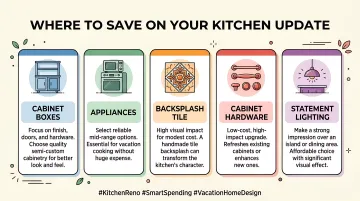
Cabinet boxes - the actual structural cabinet frames - do not need to be the most expensive option. The finish, the hardware, and the quality of the doors make far more visual difference than the box construction. Good semi-custom cabinetry with quality hardware often outperforms premium custom cabinetry with basic hardware in terms of how it looks and feels to use.
Appliances beyond the essentials can be mid-range without significant sacrifice. A reliable mid-range range and a decent microwave are perfectly adequate for vacation cooking.
Backsplash tile offers a huge visual impact for relatively modest cost. A beautiful handmade tile backsplash can be installed for $800 to $1,500 in materials and labor and dramatically changes the character of the kitchen. This is one of the best budget-to-impact investments in a kitchen update.
Cabinet hardware is another high-impact, low-cost upgrade. New pulls and knobs in the $100 to $300 range for a full kitchen update can completely refresh the look of existing cabinetry. If your cabinets are structurally sound but visually dated, hardware and paint are your best tools before committing to a full replacement.
Statement lighting over an island or dining area in the $200 to $600 range makes a significant visual impression. This is not where to cut corners, but it is also not an area that requires enormous expense. If you are also thinking about how the kitchen fits into a broader vacation home styling vision, vacation home styling services can address the full picture together.
Your Quick Recap
The vacation home kitchen is where the best parts of a vacation happen - the long breakfasts, the group dinners, the morning coffee ritual, the kids helping with a meal for the first time. Designing it well is not about following trends or maximizing a number. It is about creating a space where people can be fully present with each other.
Here is what I come back to with every client:
- Design for how the space will actually be used - multiple people, varying skill levels, relaxed pace
- Choose materials that hold up without requiring your attention - the right countertop and floor let you stop worrying and start enjoying
- Organize storage logically so anyone can navigate the kitchen from day one without frustration
- Invest in the island - it pays off in daily use in ways that few other elements do
- Layer your lighting so the kitchen can shift from bright and functional during cooking to warm and atmospheric during evenings
- Let the regional style be specific - a vacation home that feels distinctly like where it is creates a sense of place that generic design never achieves
- Spend on what you use every day; save on what is primarily visual
If you're still feeling stuck and haven't been able to move things forward, let's talk. I can help you sort through the options, identify what matters most for your space, and create a plan that feels manageable. Reach out for a free consultation at 408-306-5003, and we can take it from there.
Frequently Asked Questions
What makes a vacation home kitchen different from a primary kitchen?
Vacation kitchens typically serve larger groups, host people with varying cooking habits, and operate during concentrated periods of heavy use. They need more open flow, more prep space, and more intuitive organization than a kitchen designed for one or two people following daily routines. The materials also need to handle heavier use without demanding intensive maintenance, since you are not there every week to manage upkeep.
What countertop material works best for a vacation home kitchen?
Quartz engineered stone is my top recommendation for most vacation home kitchens. It is non-porous, requires no sealing, resists staining from wine, coffee, and acidic foods, and holds up to the range of cooking tasks that happen during family gatherings. Granite is a beautiful option if you are committed to annual sealing. Natural stone that requires more maintenance can be a good choice if your specific habits support it.
How much space should I plan for around a kitchen island?
Plan for at least 36 inches of clearance on all sides of an island, and 42 to 48 inches behind any counter or island surface where people will be actively cooking or working. This allows people to pass behind someone working without disruption, which matters significantly when multiple people are using the kitchen at once.
What type of flooring holds up best in a vacation kitchen?
Luxury vinyl plank with a 20-mil wear layer is the most practical choice for most vacation kitchens. It is completely waterproof, handles sand and tracked-in debris without scratching, cleans easily, and comes in wood-look finishes that are genuinely attractive. Large-format porcelain tile is an excellent alternative, especially in coastal kitchens with significant moisture and sand exposure.
How do I design a kitchen that feels right for a beach house versus a mountain cabin?
Coastal kitchens work best with light palettes, natural textures like rattan and light wood, shiplap or beadboard details, and a strong indoor-outdoor connection. Mountain and cabin kitchens call for warmer tones, reclaimed or knotty wood, stone accents, wrought iron hardware, and cozy lighting that reinforces the sense of gathering. The key is committing to the character of the location rather than defaulting to a generic kitchen style.
Where should I prioritize my budget in a vacation kitchen renovation?
Invest in the island, countertops, flooring, and primary appliances - the things you use every single day. These have the greatest impact on how the kitchen feels to live in. Save on cabinet boxes and specialty appliances. Use backsplash tile and cabinet hardware as high-impact, lower-cost tools for creating a strong visual impression.
How important is kitchen storage in a vacation home?
Very important - but in a different way than a primary kitchen. The goal is not maximum storage volume but logical, intuitive organization. People who are unfamiliar with your kitchen need to be able to find what they are looking for quickly. Deep drawers for cookware, a well-organized pantry, clear containers for staples, and logical placement of items dramatically reduce the daily friction of using a kitchen that is not your own.