Relocation program design services exist to answer that question. They bring together workplace strategy, space planning, move logistics, change management, and business continuity planning into a single coordinated effort so that the move doesn't just happen - it happens well.
If you're responsible for planning or overseeing a workplace relocation, this guide will walk you through everything that goes into a well-run program. I'll share what I've seen work, what tends to go wrong, and where the real leverage points are.
Your Quick Summary
- Relocation program design is not just logistics - it is a workplace strategy exercise that shapes how your organization works for years after the move
- Workplace strategy should happen before any space decisions are made - understanding how people actually work determines what the new space needs to do
- Space planning and FF&E planning are separate disciplines and both require lead time that most organizations underestimate
- Change management and stakeholder communication are the most commonly skipped steps, and the most commonly cited causes of post-move dissatisfaction
- Business continuity planning protects revenue and operations during a period when both are genuinely at risk
- Post-move evaluation is not optional - it closes the feedback loop and surfaces the fixes that prevent small friction from becoming permanent dysfunction
What Are Relocation Program Design Services?
Relocation program design services are a structured set of professional services that help organizations plan, coordinate, and execute a move from one physical location to another. The scope can range from a single floor of a corporate office to a full campus consolidation, a healthcare facility transition, or a multi-site educational institution move. These services are often delivered by interior designers and workplace design consultants who specialize in commercial and institutional environments.
In my experience, people often assume a relocation is primarily a logistics exercise - get the boxes from here to there, reconnect the technology, and get back to work. That view misses most of what actually makes a relocation succeed or fail.
A well-designed relocation program covers:
- Workplace strategy and pre-move space assessment
- Space programming and planning for the new location
- Furniture, fixtures, and equipment (FF&E) planning and procurement
- Move management and phasing
- Technology and infrastructure coordination
- Stakeholder communication and change management
- Business continuity planning
- Post-move evaluation and optimization
The goal is not just to complete the move. The goal is to arrive at a new space where your organization works better than it did before - and where the disruption to people and operations was managed down to the minimum possible level.
Workplace Strategy Before a Move
One mistake I see often is organizations that jump straight to space planning without first doing workplace strategy. They find a building they like, measure the square footage, count the headcount, and start drawing desks. Then six months after the move they realize the new space doesn't actually support how their people work.
Workplace strategy is the analytical step that happens before any design decisions are made. It answers the questions: How do your people actually work right now? How do you want them to work in the new space? What does the organization need the workplace to do?
Utilization Analysis
If you have an existing space, start there. What is your actual utilization rate - not how many people are assigned to desks, but how often those desks are occupied? In my experience, most organizations are operating at between 50% and 70% utilization in their assigned seating environments, even before hybrid work became normalized.
Utilization data tells you how much space you actually need, which is often less than you think. It also tells you what kinds of spaces are undersupplied - collaboration rooms, quiet focus zones, phone booths - and what is chronically over-built.
Workforce Planning Integration
A relocation is a multi-year commitment. The space you design today needs to work for the organization you'll be in three to five years from now, not just the one you are today. That means integrating your HR and workforce planning data into the space program.
What is your headcount trajectory? Are you expecting growth, consolidation, or significant shifts in work patterns? Are certain teams moving toward fully remote or hybrid models? How does the balance between in-office and distributed work affect what you actually need in a physical location?
Culture and Work Mode Assessment
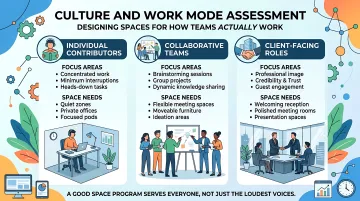
Here's where I would start if I were joining your project at the strategy phase: a structured assessment of how different teams in your organization actually work. Not how the org chart says they work. How they actually work.
Some teams are heads-down individual contributors who need quiet, focused environments. Some are highly collaborative and need flexible spaces that reconfigure quickly. Some are client-facing and need a physical presence that communicates credibility and professionalism. Most organizations have all three, and a good space program serves all of them - not just the loudest voices in the room.
Space Planning and Workplace Design
Once workplace strategy is complete, space planning translates your organizational requirements into physical space decisions. This is where headcounts become seat counts, work modes become zone types, and cultural requirements become design specifications.
Space Programming
Space programming is the document that bridges strategy and design. It defines the total amount of space you need, broken down by space type - individual workstations, offices, collaboration rooms, support spaces, amenities - and the adjacency requirements between teams and functions. Working with space planning specialists at this stage ensures the program reflects real operational requirements rather than generic benchmarks.
In my experience, the space program is where a lot of relocations either get it right or start going wrong. If the program is grounded in real utilization and workforce data, the design that follows tends to work. If the program is built on assumptions or gut feel, you end up with spaces that look right on paper but don't function the way people need them to.
Workplace Design Principles
Good workplace design for a relocation program is not about aesthetics first. It is about function first, and then making the function beautiful.
The principles I apply consistently:
- Variety of space types. People do different kinds of work throughout the day. They need individual focus spaces, small group collaboration spaces, large team meeting spaces, and informal interaction zones. A workplace that only offers rows of open desks or a sea of closed offices is failing most of its occupants most of the time.
- Acoustic management. Open-plan environments are one of the most consistent sources of employee dissatisfaction when they're not designed with acoustics in mind. Sound masking, acoustic ceiling treatments, and the thoughtful placement of collaboration zones relative to focus zones all matter.
- Flexibility and adaptability. Organizations change. The space you design should be able to accommodate reasonable changes without requiring a full buildout. Movable walls, modular furniture systems, and technology infrastructure that isn't locked into fixed locations all contribute to long-term adaptability.
- Wellbeing and amenity. Access to natural light, quality air, places to eat and have informal conversations, and outdoor or respite spaces all have documented effects on employee satisfaction and productivity. These are not luxuries in a new space - they are investments in retention and performance.
Test Fit and Design Development
Before committing to a space, run a test fit. A test fit is a preliminary layout exercise that checks whether your space program can actually be accommodated within the building footprint and floorplate configuration you're considering.
I usually recommend completing test fits for two or three candidate buildings before the lease is signed. Once the lease is signed, you're designing around what the building gives you. Test fits done in advance give you real information to inform the leasing decision.
Furniture, Fixtures, and Equipment Planning
FF&E planning is one of the most time-sensitive and frequently underestimated components of a workplace relocation. Furniture lead times - especially for custom or specification-grade commercial products - typically run 8 to 16 weeks for standard orders, and longer for anything with custom finishes, fabrics, or configurations.
One mistake I see often is organizations that treat FF&E as a late-stage decision. They spend six months on the lease and the design, then start furniture conversations three months before move-in. At that point, lead times have already compressed the available options and elevated the costs.
FF&E Audit of Existing Assets
Before purchasing anything new, conduct a thorough audit of your existing FF&E. What can be reused in the new space? What needs to be refurbished or repaneled? What has reached end of life and needs to be replaced?
In my experience, most organizations can reuse between 30% and 60% of their existing furniture in a well-planned relocation. That percentage drops when organizations skip the audit and make purchasing decisions without knowing what they already have.
FF&E Specification and Procurement
For items that need to be purchased, specification is the process of defining exactly what you're buying - manufacturer, model, finish, fabric, configuration - so that procurement can proceed on a defined budget and timeline.
This matters for several reasons. First, it prevents scope creep and budget surprises. Second, it ensures that what arrives on the truck matches what was drawn on the plan. Third, it gives you a documented record that makes warranty claims, replacements, and future additions much simpler to manage.
Technology and Infrastructure Coordination
FF&E planning needs to be coordinated with your technology and AV infrastructure decisions. Workstation designs affect cable management and power access. Conference room furniture selections affect AV equipment placement and sightlines. Phone booth and focus room configurations affect acoustic performance and technology integration.
What I've seen with clients who treat these as separate workstreams is expensive rework - furniture that arrives and can't accommodate the technology that was specified independently, or AV installations that were planned without knowing the final furniture configuration.
Move Management and Logistics
Move management is the operational discipline that takes your space plan from paper to physical reality. It covers the phasing, sequencing, scheduling, and coordination of the physical move itself - including people, furniture, technology, records, and support services.
Phasing Strategy
How you phase a move matters enormously for business continuity and cost. A well-designed phasing strategy moves people in logical groups - by team, by floor, by function - so that each phase is a complete, self-contained move rather than a fragmented partial occupation.
I usually recommend against big-bang moves when the size of the organization or the complexity of the space makes them avoidable. Moving everyone at once creates a single point of failure: if something goes wrong, it affects everyone. Phased moves distribute that risk.
Vendor Coordination
A workplace relocation involves multiple vendors operating in parallel - moving companies, FF&E installers, technology vendors, facilities management, and potentially specialty contractors for lab equipment, healthcare technology, or secure records. Each vendor has their own timeline, dependencies, and constraints.
Move management involves holding all of those timelines together in a single master schedule and actively managing the dependencies between them. The moving company can't position furniture until FF&E installation is complete. IT can't configure workstations until the moving company has positioned them. These sequencing dependencies, if not actively managed, create the delays and cost overruns that characterize poorly managed relocations.
Day-One Readiness Planning
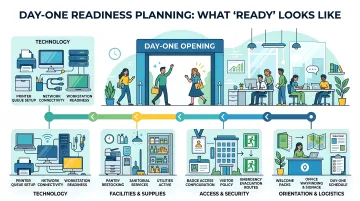
Day-one readiness is a specific planning exercise that works backward from the first day people occupy the new space. What does "ready" look like? What does every person need to be able to do their job on day one? Who is responsible for each element of readiness?
In my experience, day-one readiness planning surfaces a remarkable number of things that were assumed but not actually assigned to anyone. Signage. Pantry restocking. Badge access configuration. Print queue setup. Emergency evacuation routes. All of these seem like someone else's problem until they become no one's problem the morning the space opens.
Stakeholder Communication and Change Management
This is the section most relocation programs either rush through or skip entirely. And it is consistently one of the top sources of post-move dissatisfaction.
Workplace relocations are change events. Even when the new space is demonstrably better, people experience it as a disruption to routines, relationships, and the physical environment that shapes how they feel about coming to work. Change management acknowledges that reality and creates a structured approach to helping people navigate it.
Building a Communication Strategy
A communication strategy for a relocation program should cover the full arc of the project - from the initial announcement through move-in and the adjustment period that follows.
What I've seen with clients who communicate well is that even employees who were skeptical about the move tend to settle into the new space with less friction. What I've seen with clients who under-communicate is that rumors fill the information vacuum, and those rumors are almost always worse than the reality.
The communication plan should address:
- What information will be shared, and when
- Who the appropriate messengers are for different audiences (senior leadership, direct managers, project team)
- How feedback and questions will be collected and responded to
- How the organization will acknowledge concerns rather than dismissing them
Change Champions and Floor Warden Programs
One of the most effective tools I've used in relocation change management is a distributed network of change champions - employees embedded in each team or department who are briefed ahead of the general population, understand the rationale for key decisions, and can be a local resource for questions and concerns.
This is not the same as asking people to be cheerleaders for a decision they didn't make. It's giving them real information and a real role, so that when their colleagues ask questions, there's someone who can give a grounded, honest answer.
Floor wardens serve a similar function on the operational side - responsible for ensuring their area is ready, documented, and cleared before the move and that their team members know what to do on move day.
Supporting Employees Through Workplace Change
Some employees will be genuinely affected by the move in ways that go beyond inconvenience. Longer commutes. Loss of a private office. Change in how their team is seated. Disruption to the informal social networks that make a workplace feel like a community.
Acknowledging these impacts directly - rather than expecting people to be uniformly positive about a decision that serves the organization's interests - builds the kind of trust that helps organizations navigate change better over time.
Business Continuity During Relocation
Business continuity planning for a relocation is about one thing: ensuring that the organization can continue to serve clients, generate revenue, and operate critical functions throughout the transition period.
In my experience, this is where organizations most often underestimate the risk. A relocation compresses a lot of operational complexity into a short window. Technology migrations can create downtime. Physical access to materials and equipment can be interrupted. Key personnel are distracted by move logistics at the same moment client or project demands don't pause for the transition.
Identifying Critical Functions
Start with a clear-eyed assessment of which functions in your organization cannot tolerate interruption, even briefly. Client-facing operations. Revenue-generating activities. Regulated processes that have compliance or contractual obligations attached.
Once you've identified those functions, work backward to understand what physical resources, technology, and people they depend on - and build a specific continuity plan for each one.
Technology Migration Planning
Technology is usually the longest lead-time component of a relocation and the most disruptive when it goes wrong. Network infrastructure, server migrations, VoIP systems, AV configurations, and end-user device reconfiguration all need to be planned and tested before they're needed on day one. Organizations managing complex technology environments alongside physical moves often benefit from virtual design services that allow distributed teams to review and approve space plans and configurations remotely, without requiring everyone to be on-site at every decision point.
What I usually recommend is running parallel systems where feasible - maintaining connectivity in both locations during the transition rather than doing a hard cutover. This is not always possible, but when it is, it dramatically reduces the risk of extended technology downtime.
Communication Continuity
Make sure your clients, partners, and vendors know how to reach you during the transition. Update contact information, office addresses, and any public-facing directories well in advance of the move. Designate a point of contact who can handle any communication issues that arise during the transition window.
Common Relocation Challenges and How to Avoid Them
In my experience, the same challenges show up in relocation programs across industry types and organization sizes. Knowing what they are in advance is the most reliable way to avoid them.
Underestimating Lead Times
FF&E lead times, construction timelines, IT infrastructure procurement - all of these routinely take longer than first estimates suggest. What I've seen with clients who start these workstreams early is that they have options when delays occur. What I've seen with clients who start late is that they have no options, only expensive workarounds.
The fix: build your master schedule by working backward from your occupancy date, with realistic lead times for every workstream, and then add a buffer. The buffer will be used.
Scope Creep in Design
Relocations are exciting. New space generates new ideas. People who weren't engaged in the process at the start suddenly have opinions about finishes, layouts, and amenities once they can see a floor plan. This is normal, and it's manageable - but only if scope change has a defined process.
Every change to the program after a certain point has a cost: time, money, or both. A clear scope lock date, with a defined process for evaluating and approving changes after that date, protects the project and the people managing it.
Employee Resistance
Even objectively better spaces generate resistance when people feel they weren't part of the decision. The antidote is not more communication about why the decision was right - it is earlier involvement in shaping what the outcome looks like.
Engaging employees in workplace design through surveys, focus groups, and test-fit walkthroughs before the space is finalized gives you better information and generates the kind of ownership that turns skeptics into advocates.
Technology and Facilities Misalignment
When the technology team and the facilities team are planning in separate workstreams with separate schedules, misalignment is inevitable. Power and data drops don't match the furniture plan. AV systems arrive before the rooms they're going into are complete. Network infrastructure isn't ready when IT needs to begin configuration.
The fix is integration - a single master schedule that includes every workstream, with clear owners and dependencies mapped across each other.
Budget Overruns
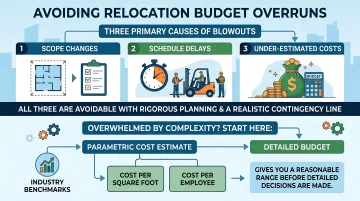
Relocation budgets blow out for three primary reasons: scope changes, schedule delays, and under-estimated costs in the original budget. All three are avoidable with rigorous planning and a realistic contingency line.
If you're feeling overwhelmed by the budget complexity of a relocation, I usually recommend starting with a parametric cost estimate - a high-level estimate based on industry benchmarks for cost per square foot or cost per employee - before developing the detailed budget. It gives you a reasonable range to plan against before the detailed decisions are made.
Post-Move Evaluation and Optimization
The relocation program doesn't end when people walk into the new space for the first time. That's when a different phase begins: understanding how the space is actually performing, and making the adjustments that turn a good space into a great one.
The 30-60-90 Day Framework
I usually recommend a structured evaluation at 30, 60, and 90 days post-move. Each checkpoint serves a different purpose.
At 30 days, you're collecting first impressions - what's working, what's clearly not working, and what immediate fixes are needed. Technology issues, facilities snags, and acute space planning problems tend to surface here.
At 60 days, patterns begin to emerge. Teams have settled into the space enough to know what's working for their work modes and what isn't. This is when you start to see whether collaboration spaces are being used as intended, whether focus zones are providing adequate acoustic separation, and whether the adjacencies you planned are actually generating the interaction you expected.
At 90 days, you have enough data to make strategic decisions. Are there spaces that are chronically over-utilized? Under-utilized? Are there teams requesting moves because the original adjacency plan isn't serving them? Are there behavioral patterns - employees working in corridors, taking calls in stairwells - that signal a mismatch between the space and how people need to work?
Utilization Monitoring
If you have the technology infrastructure to support it, ongoing space utilization monitoring gives you real data on how the space is performing over time. This doesn't have to be complex - even simple badge access data and meeting room booking analytics provide useful information about which spaces are working and which aren't.
This data also supports future planning. When your lease comes up for renewal in five or seven years, you'll have actual utilization data to inform that conversation rather than assumptions.
Optimization Actions
Post-move optimization is about making targeted changes based on what you've learned. This might mean reconfiguring an area that was designed for a work mode that turned out not to be how the team actually functions. It might mean adding acoustic panels to a collaboration zone that's generating too much noise bleed into adjacent focus areas. It might mean converting an underused large conference room into smaller breakout spaces because booking patterns show the large room is almost never fully occupied. A home renovation consultation approach - targeted, scoped, and responsive to what the space actually needs rather than a full redesign - is often the right frame for this kind of post-move work.
What I've seen with clients who skip the post-move evaluation is that the space calcifies - the problems that existed at day one are still there at year two, because no one closed the feedback loop that would have surfaced them as problems to solve.
When to Work With a Relocation Program Design Partner
If you're feeling overwhelmed by the scope of what a well-run relocation program involves, that's a normal response. A major workplace relocation is genuinely complex, and the organizations that do it best are usually the ones that recognize early what they need help with.
Signs You Need External Support
Here's where I would start if you're trying to decide whether to bring in outside expertise:
- You're managing the relocation alongside your existing responsibilities, with no dedicated internal resource to own the program
- Your organization hasn't done a major relocation in the last five to seven years and institutional knowledge has turned over since then
- The scale of the move - number of people, number of locations, complexity of the operations being moved - exceeds what your internal facilities or HR team has experience managing
- Key workstreams (workplace strategy, space planning, FF&E, change management) are being managed by different people with no integrating function holding them together
- Your timeline is tight relative to the complexity of what needs to happen
What a Good Partner Brings
A professional design consultant or relocation program design partner brings three things that are hard to develop internally for a single project: experience, methodology, and bandwidth.
Experience means having managed enough relocations to know where the risk lives, what the common failure modes look like, and how to navigate vendor relationships and timeline pressures. Methodology means having a structured approach to each workstream that doesn't have to be invented from scratch on your project. Bandwidth means having people whose primary job is the relocation program - not a secondary responsibility layered on top of an existing role.
In my experience, the investment in a good relocation partner pays back in reduced costs, fewer delays, and an outcome that actually reflects the strategic intent of the move - not just a functional space, but a space that supports the way your organization needs to work.
Your Quick Recap
A workplace relocation is one of the most complex change events an organization can undertake. When it's planned well, it's an opportunity to reset the physical environment to match how the organization works and where it's going. When it's planned poorly, it's months of disruption, cost overruns, and employee dissatisfaction that outlasts the move itself.
The key principles:
- Start with workplace strategy, not space planning - understand how your people work before deciding what the new space needs to do
- Give FF&E and technology workstreams the lead time they actually require, not the lead time that feels comfortable in the moment
- Treat change management as a core workstream, not an afterthought - people are the point of the whole exercise
- Build a business continuity plan for the transition period before you need it
- Close the feedback loop after the move - the post-move evaluation is what turns a completed project into a continuously improving workplace
If you're still feeling stuck and haven't been able to move your relocation plans forward, let's talk. I can help you sort through the moving pieces, identify your priorities, and create a roadmap that feels manageable. Reach out for a free consultation at 408-306-5003, and we can work through the next steps together.
Frequently Asked Questions
What is the difference between relocation program design services and a standard moving company?
A moving company handles the physical transport of furniture and equipment from one location to another. Relocation program design services cover the full scope of planning that precedes, accompanies, and follows that physical move - including workplace strategy, space planning, FF&E coordination, technology migration, change management, and business continuity. The two are complementary, but they address very different problems.
How far in advance should an organization begin planning a workplace relocation?
For a relocation of any meaningful scale, I usually recommend beginning the planning process 12 to 18 months before the intended occupancy date. This provides sufficient lead time for workplace strategy, space planning, design development, FF&E procurement, and technology infrastructure preparation. Organizations that start 6 months out are already behind on several workstreams.
What is included in a workplace strategy for a relocation?
A workplace strategy for a relocation typically includes a utilization analysis of the current space, a headcount and workforce planning review, a work mode assessment that characterizes how different teams operate, an adjacency analysis, and a space program that translates all of those inputs into specific space requirements for the new location.
How do relocation program design services support business continuity?
Business continuity support in a relocation program includes identifying critical functions that cannot tolerate interruption, planning technology migrations with parallel-system strategies where feasible, sequencing physical moves to minimize operational downtime, and maintaining communication continuity with clients and partners throughout the transition.
What should we evaluate after the move is complete?
Post-move evaluation should include employee feedback surveys at 30, 60, and 90 days; space utilization monitoring to understand which areas are over- and under-utilized; review of any open facilities or technology snags; and an assessment of whether adjacency and work mode assumptions from the space program are holding up in practice.
When does it make sense to hire a relocation program design partner versus managing the process internally?
It generally makes sense to bring in external expertise when the relocation is large or complex, when the internal team lacks bandwidth or prior relocation experience, when multiple workstreams need to be integrated under a single program structure, or when the timeline is tight enough that planning errors will be costly to correct. For straightforward small-office moves with experienced internal project management, internal management may be sufficient.